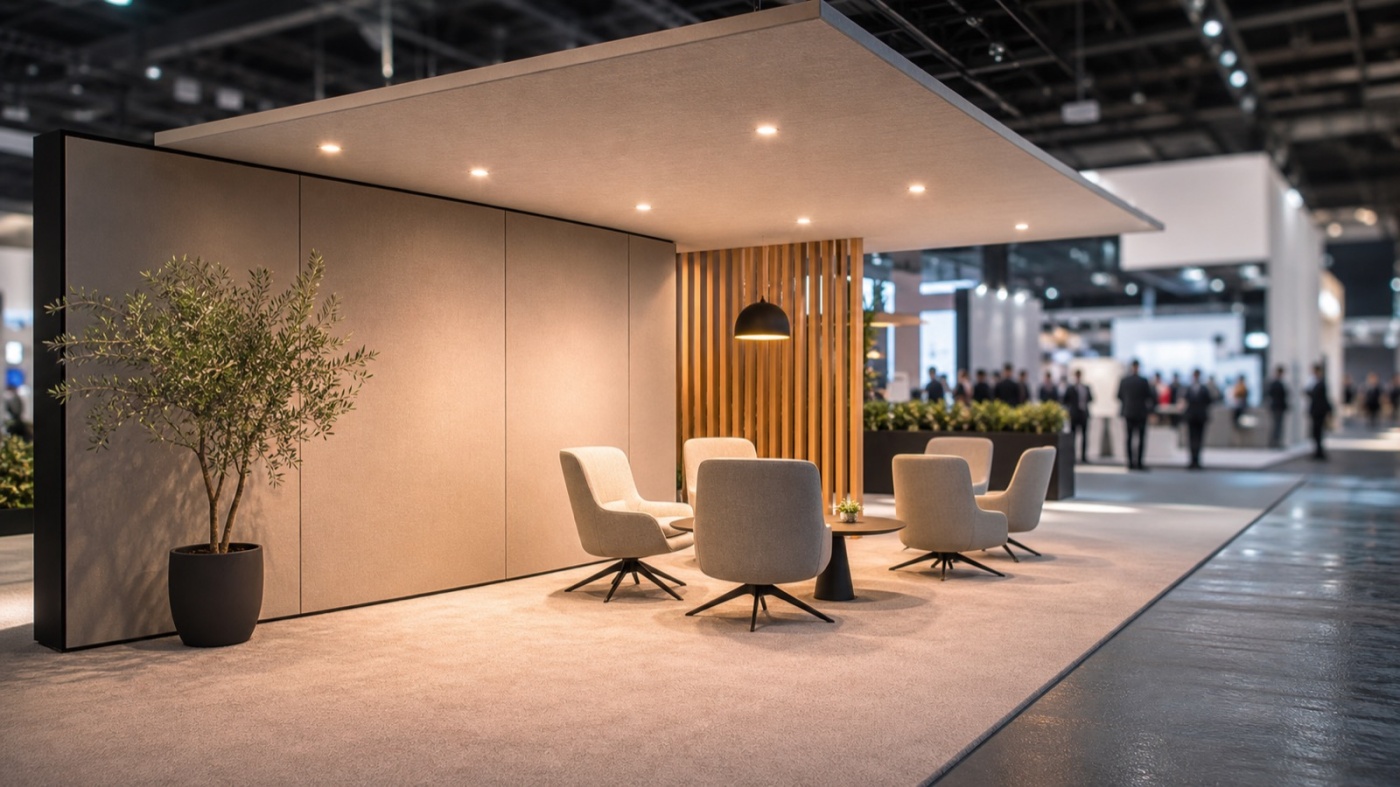
Two people stand half a metre apart and still work hard to follow each other. On a trade fair floor that is everyday life: the background level in a full hall runs high, and every voice that pushes through raises it further. A handful of design decisions bring the calm back, long before the first loudspeaker arrives.
Why exhibition halls get so loud
Exhibition halls are large, tall and acoustically hard. Concrete, steel, glass and sheet metal reflect sound instead of absorbing it. What fades quickly in an office keeps ringing here and lands on top of the next word.
A human reflex adds to it. In noisy surroundings speakers raise their voices without noticing, an effect acousticians call the Lombard effect. Across several thousand square metres with hundreds of parallel conversations, the level lifts itself.
A useful rule of thumb for speech intelligibility puts the voice around ten decibels above the background noise. You reach that margin either through more volume or through less ambient sound arriving at the listener's ear. The second route carries you through a full fair day, while the first costs voices by day three.
Put absorption where it earns its space
Absorbers take in sound energy instead of reflecting it. Their performance is expressed as a weighted sound absorption coefficient, which EN ISO 11654 sorts into classes A to E; class A starts at 0.9. Speech lives mainly between roughly 250 and 4,000 hertz, and in that range porous materials with sufficient thickness or an air gap behind them work most reliably.
The largest free surface sits above you. Suspended ceiling rafts or baffles over the meeting area therefore deliver the strongest effect per square metre. Suspensions require approval depending on the hall and the organiser, so an early look at the technical regulations clarifies rigging points, loads and deadlines.
On the walls, one detail decides everything: stretched fabric on its own absorbs very little. Only with an absorber fleece inside the frame, or with an air cavity behind the tensioned surface, does a wall become acoustically effective. Modular aluminium frames suit this well, because the infill can be swapped from project to project. Our page on renting an exhibition stand shows modular systems in use.
On a smaller scale, carpet helps (mostly against high frequencies and footfall noise), together with upholstered furniture, heavy curtains, molton behind graphic panels and well filled shelving. Plants look good and contribute little acoustically, while remaining useful as a visual screen.
The floor plan is your best sound insulation
Layout decides before any material does. A closed back wall shields the stand, and the meeting area belongs in the quietest corner, at a distance from the aisle, the neighbouring stage and the hall gate. A roofed cabin performs far better than half height partitions, because sound diffracts over every edge. Permitted construction heights and sight screens come from the technical regulations of the respective venue.
Distance is acoustics as well. In a free field the level drops by six decibels each time the distance to the source doubles; inside a hall the gain is smaller, because the diffuse field dominates. In practice: place seating groups close together, keep speaking distances short and hold conversations across the table rather than across the room.
Then there is the neighbourhood. The hall plan reveals early where stages, food courts, escalators and gates sit. Booking your space in good time means choosing calm along with the location. Where a neighbouring stage is already confirmed, an early conversation about show times helps more than any extra wall.
Sound on the stand: directional rather than loud
Many organisers cap the sound level at the stand boundary. The applicable figure comes from the technical regulations of the respective fair, and it differs from venue to venue. Either way, one principle pays off: bring the sound as close to the ear as possible.
Small speakers at ear height right beside the seating group reach their listeners with a fraction of the level that a system firing from the corner of the stand requires. Directional arrays focus the energy further forward. For demonstrations, wireless headphone systems are an elegant answer: every listener receives a clean signal, several language channels run in parallel, and the hall stays calm.
In the technical setup, speech intelligibility counts for more than fullness of sound. A headset or lavalier microphone keeps the presenter's hands free and the distance to the mouth constant. Low frequencies can be rolled back, while the presence range carries the words. Fixed show times work better than continuous playback and spare your stand team at the same time.
Test during build-up, adjust once the hall fills
An empty hall sounds completely different from a full one: people, textiles and exhibits absorb a great deal. Plan two checkpoints. During build-up you verify positions and basic settings, and on the first morning of the fair you fine-tune.
A speech test in the meeting area, once facing the aisle and once turned away, shows within two minutes whether the layout holds. A sound level app on a smartphone gives rough orientation across the day, which is enough to judge show times and seating positions.
Brief your team accordingly: speak calmly and clearly rather than louder, choose a position with your back to the noise source, guide visitors into the sheltered zone, and keep water available. Voices stay fresh until the final day and conversation quality improves immediately.
Plan acoustics while the layout is drawn
Absorbers can be retrofitted, floor plans rarely can. Anyone who thinks about the meeting zone, the back wall and the ceiling area acoustically from the start holds calmer, longer and more productive conversations on site, and that is where the value of a trade fair appearance is decided. Examples from completed builds are collected in our project references, and for your specific hall and stand type a short conversation clarifies which measures really pay off.