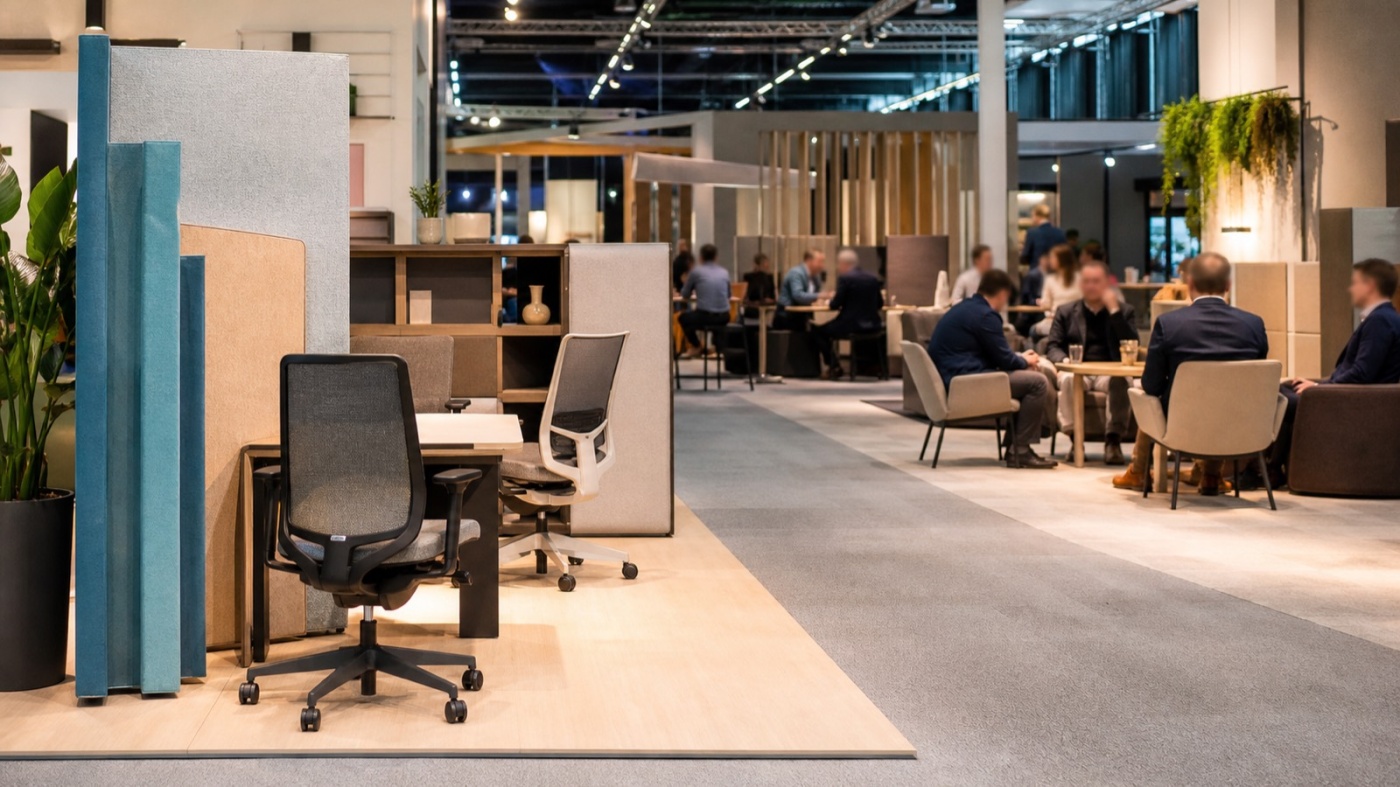
Roughly half of the people who pause at your stand in Cologne have travelled in from abroad. ORGATEC brings architects from Milan, buyers from Seoul and workplace planners from Rotterdam past your counter within the same quarter of an hour. Design for that mix from the first sketch, and you win conversations that others walk past.
Cologne as a stage for the future of work
ORGATEC is the international leading trade fair for modern working environments and takes place every two years at the Koelnmesse grounds. The next edition runs from 27 to 30 October 2026, followed by the 2028, 2030 and 2032 editions. Four show days, with a professional audience drawn from architecture, interior design, contract planning, facility management, retail and procurement.
The 2024 edition shows how international the field really is: more than 50,000 visits from 126 countries with an overseas share of around 56 percent, plus 738 exhibitors from some 40 countries. For 2026 the organiser again reports broad international participation and a more compact hall layout that groups the product segments: Workspace Solutions occupies the northern halls, Contract Solutions sits in halls of its own. Your registration determines which hall suits your segment. Our trade fair calendar gives you this date alongside the rest of the season.
For stand design the consequence is straightforward. In Cologne your presence speaks to people with very different reading habits, technical vocabularies and expectations of hospitality. A stand tailored to the home market alone leaves the larger share of the audience to chance.
Language on the stand: four layers that work together
Multilingual communication happens on several layers, and each layer follows its own logic.
Long distance carries a single statement. On the back wall or the fascia, English works most reliably as the default language, ideally supported by one short line in German. Three to five words are enough for the message to land from ten metres away.
At mid distance the exhibit labels take over. A fixed bilingual grid earns its keep here: the English term on top, the German term below, same size, same spacing. Allow spare room in the layout, because German technical terms tend to run noticeably longer than their English equivalents. A layout sized for the shorter language alone comes under pressure during translation.
Depth belongs in digital form. A QR code on the exhibit leads to a product page that recognises the language of the device. The stand stays visually calm while prospects from ten countries each read their own version. Downloadable data sheets replace the suitcase full of printed variants.
The fourth layer is your team. A small language code on the name badge (EN, IT, PL, TR) shows within seconds who will take which conversation. It reads as an invitation and spares your guests the question of whether they will be understood.
Small courtesies that travel well
Hospitality is read differently around the world, and that is precisely where the opportunity sits.
Offer two conversation settings side by side: an open standing welcome for the quick technical exchange, and a seated zone for negotiations that run longer or involve an interpreter. Presented together, both let every guest choose the format that suits them.
Breadth pays off in catering: decaffeinated and alcohol-free drinks, vegetarian and vegan snacks, water within easy reach. It costs little and signals attention to dietary habits from many regions.
Review colours, symbols and hand gestures in your imagery before print approval. A motif that feels warm in the home market may read differently elsewhere. A quick check with colleagues from your target markets settles the question fast.
Business cards and name badges belong in legible type with a job title people can decode. Internal abbreviations are better kept in the intranet.
Lead capture itself stays consent-based. Your guest decides whether and which details to leave behind, and the consent wording appears in their language. A short bilingual form on a tablet is enough and creates clarity on both sides.
Your stand as a working environment in miniature
ORGATEC comes with a twist: your stand is also your exhibit. Visitors from contract planning read acoustics, lighting, material choice and ergonomics as evidence that you understand working environments.
Acoustic elements pay off twice here. They lower the level during conversation and demonstrate your product thinking at the same time. Lighting behaves similarly: a coherent colour temperature and glare-free fixtures make textiles and surfaces credibly visible.
Because visitors try out chairs and tables, adjustability earns its place in every seating group. People of different heights experience directly how flexible your range is.
Modular system construction plays to its strengths at this show. Aluminium frames with fabric graphics carry large-format imagery, accept a fresh set of graphics in another language for the next appearance, and travel back into storage afterwards. Our page on sustainable exhibition stands explains how that approach holds up across several years.
Halls, lead time and approvals
Registration decides your hall, stand shape and neighbours, so an early start is worth a lot. A realistic lead time for concept, design, production and logistics sits at six to twelve months.
The terms of participation and the technical guidelines issued by Koelnmesse are the binding reference. They cover minimum stand size, height zones, fire protection requirements and the deadlines for dimensioned stand drawings. Special structures and rigging follow their own rules and are reviewed and released before build-up begins.
With an international audience, one item deserves its own place in the schedule: translation and proofreading. Set a dedicated milestone well ahead of print approval. That leaves time for a native-speaker review, and the graphics move into production linguistically clean.
Bilingual clarity opens international conversations
ORGATEC rewards exhibitors who aim their presence squarely at a global professional audience: clear English at a distance, dependable bilingual labelling, digital depth behind a QR code, a team whose language skills are visible, and hospitality that allows for different conversation styles. Add a stand that makes your own workplace expertise tangible.
If you are planning your appearance in Cologne, we are happy to talk through floor plan, language grid and timeline. Completed work is on show in our exhibition stand projects.