Before every larger trade fair appearance, the same question comes up: is it worth buying your own stand, or does it make more sense to rent one? The question of whether to rent or buy an exhibition stand cannot be answered with a single fixed figure, because the right choice depends above all on how often and how uniformly you exhibit during the year. This article sets out the decision in plain terms. It shows at what frequency of appearances a purchase begins to pay off, which costs keep running after the purchase, and why modular system build is a viable middle path between the two models in many cases.
The decisive figure: appearances per year
The most important factor is the number of your trade fair appearances per year. If you exhibit once a year or only irregularly, a purchased stand ties up capital that sits unused in storage most of the time. If, on the other hand, you attend fairs regularly and several times a year, you spread the one-time acquisition cost across many uses, so the price per appearance falls.
So it is not only about the purchase price, but about the cost per use over the entire service life. A stand that is used only twice stays expensive per appearance, even if the purchase price looks favourable at first glance. A stand that runs often and over several years becomes more economical with every use. This simple logic sits behind almost every purchase decision.
A worked example across three appearances
Picture three comparable trade fair appearances, without concrete amounts, thought of purely as a ratio. With renting, you pay roughly the same base amount for each of the three appearances, because you rent anew each time. Three appearances therefore mean roughly three times the rental outlay.
With a purchase, you pay the full acquisition price once, and that price is clearly higher than a single rental. Spread across three appearances, however, the share per appearance falls noticeably. Whether the purchase already pays off against renting three times depends on how far the purchase price sits above a single rental and which running costs are added on top. As a rough rule of thumb: the more similar appearances fall on the same stand, the sooner the purchase beats the sum of the individual rentals. With only a few appearances, and different ones at that, renting usually stays the cheaper calculation.
What the purchase costs on top
A purchased stand causes costs not only at acquisition. After the fair it has to go somewhere, and storage space costs money, whether in your own premises or rented. On top of that comes the effort of upkeep: components are checked, cleaned, and where needed repaired or replaced, fabric covers and graphics age and have to be renewed, and technology such as lighting or screens needs maintenance.
These running items largely fall away with renting, because storage, maintenance, and updating sit with the service provider. If you buy, you should therefore factor in the follow-up costs from the start, because they help decide whether the purchase really pays off over the years. A stand that is used rarely but permanently causes storage and upkeep costs can end up more expensive than repeated renting.
Flexibility versus planning certainty
Renting and buying also differ in how flexible you remain. If you rent, you can adjust the stand size and the design from fair to fair, without being tied to existing components. That is an advantage when your floor areas vary, when you want to try out new formats, or when your fair programme is not yet fixed. Your liquidity is also spared, because no capital is tied up over the long term.
The purchase plays to its strength when your appearance stays constant over the years. Your own stand secures a consistent brand image, because you turn up each time with the same, recognisable build. You are more independent of the availability of rented goods, and you can develop the stand in a targeted way over time. The price for that is lower flexibility, because a purchased stand fixes size and basic form for a longer period.
The middle path: modular system build
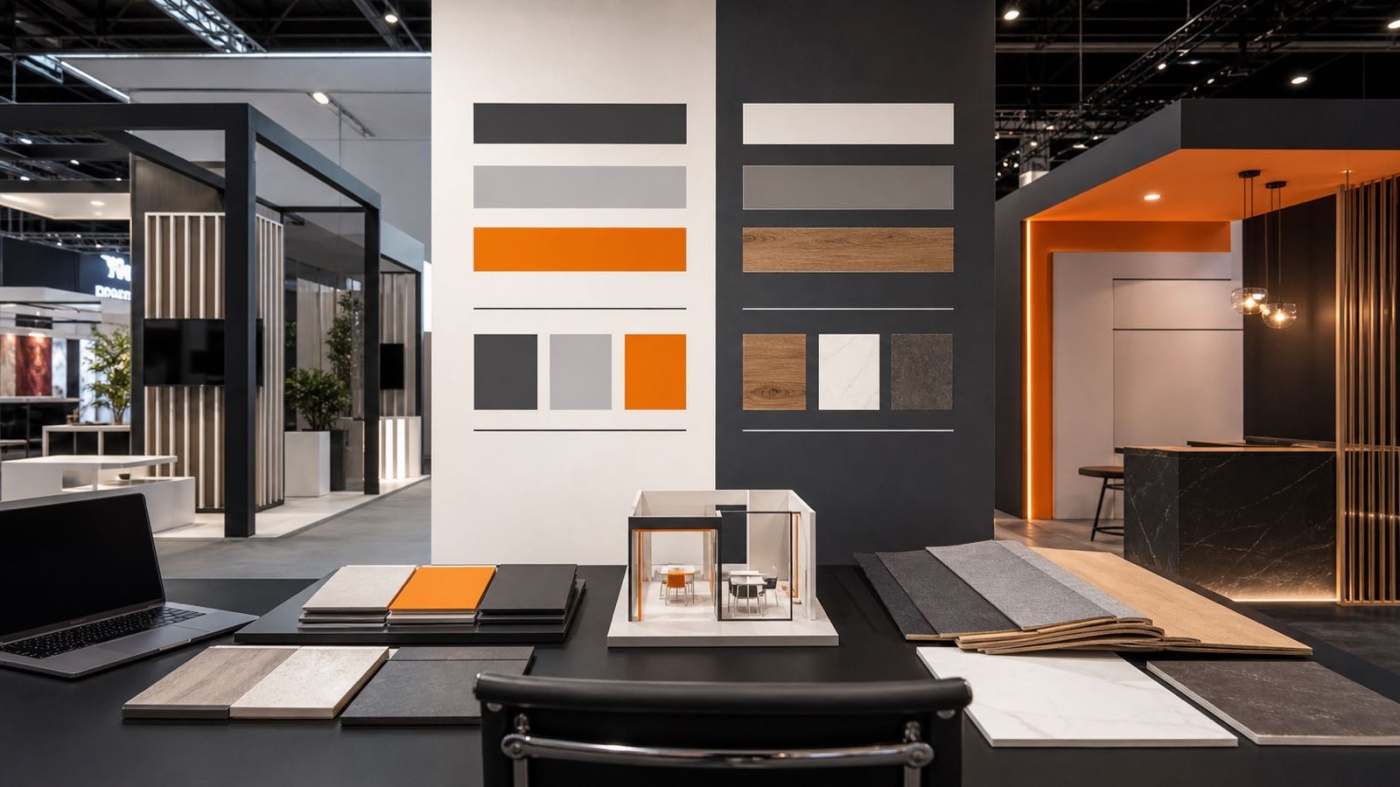
Between pure renting and classic buying stands the modular system build, and for many exhibitors this is the most practical solution. A system stand consists of standardised components, for example aluminium frames that connect without tools, plus LED tiles for illuminated surfaces and textile covers, that is fabric panels tensioned into the frames that carry the graphics. These components can be reassembled again and again.
From this comes a double advantage. You can buy your own system components and thereby secure a fixed stand image, yet still stay mobile, because the same parts can be reconfigured for a smaller or larger area. A stand built one year as an in-line stand can appear the next year as a larger corner stand, without everything having to be bought new. Only the changeable parts such as graphics or individual modules are adapted. The modular approach thus combines the reusability of buying with part of the flexibility of renting. At the same time, it is the basis for a more sustainable way of building, because components stay in the cycle across many appearances instead of being discarded after one fair.
If you first want to cover only individual appearances without committing to a purchase, renting a modular stand is a good entry point. You will find further information on the page Rent an exhibition stand in Frankfurt.
When to buy, when to rent: a short orientation
The decision can be condensed into a few guiding questions:
- Buying tends to pay off when you exhibit several times a year and over several years with a constant stand image, the areas stay similar, and you can carry storage and upkeep costs.
- Renting tends to pay off when you exhibit rarely or irregularly, the stand sizes change, you want to stay flexible, or you would rather use the tied-up capital for something else.
- Modular system build makes sense when you want a recognisable stand image but wish to keep the option of adapting size and build from fair to fair.
How these considerations play out in the concrete reality of a fair is shown by our fair-specific guides, for example on the exhibition stand for LogiMAT in Stuttgart or on the exhibition stand for FIBO in Cologne. If you want to set up your appearance cleanly in terms of timing, the overview of the schedule for trade fair planning will help.
Conclusion
Whether renting or buying an exhibition stand pays off for you is decided above all by the number of similar appearances per year, supplemented by the follow-up costs for storage and upkeep as well as your need for flexibility. If you exhibit rarely and with changing sizes, you are usually better off renting. If you appear often and with a constant stand image, you benefit from buying. And if you want to combine both, you will find a solid middle path in modular system build. If you would like to work through your situation concretely, we are happy to talk it through with you, by phone on +49 69 201 65 001 or by email to info@dietrendsetzerei.de.