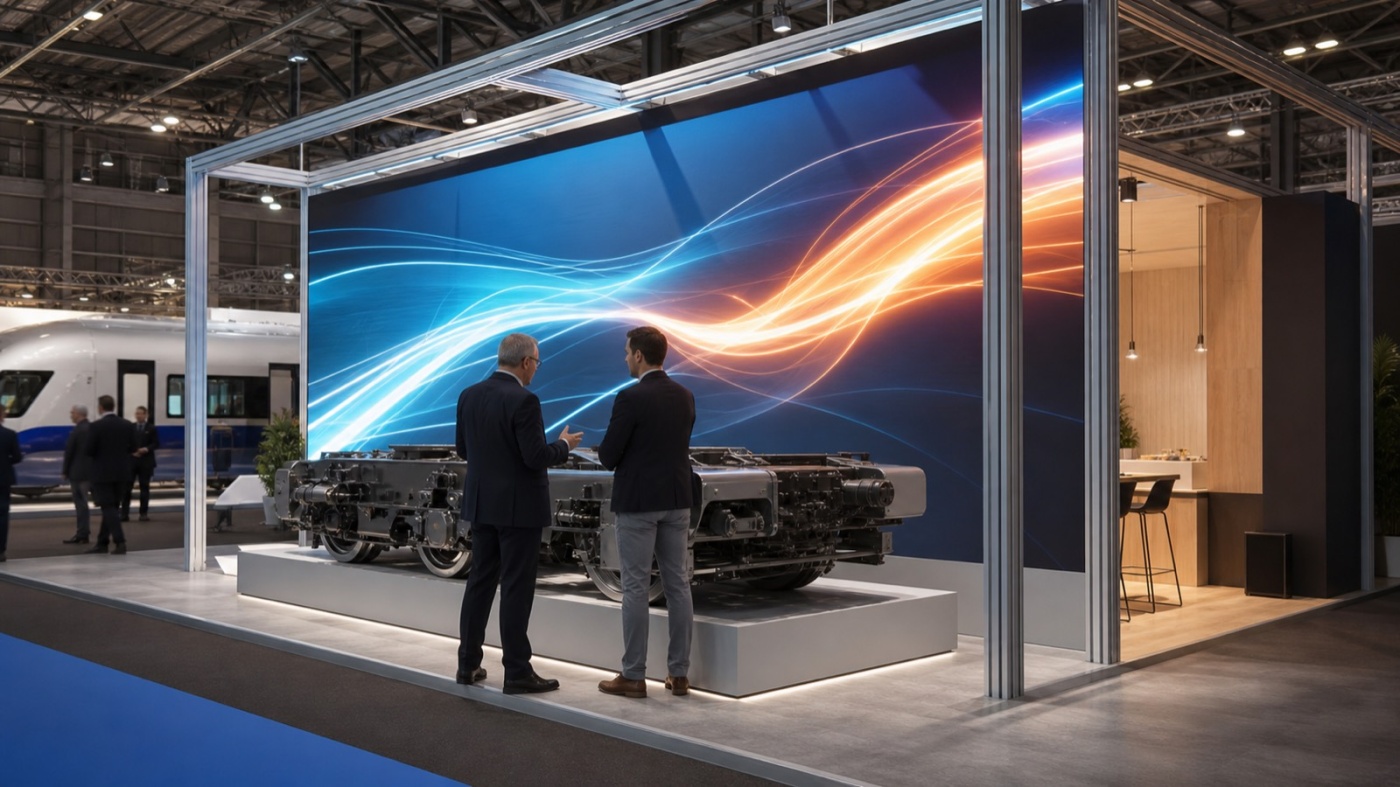
Around 3,500 metres of track, well over a hundred vehicles on the outdoor display at the last edition and 42 occupied halls: InnoTrans in Berlin is the one trade fair where a complete train becomes an exhibit. Suppliers inside the halls face an intriguing task, because their contribution usually sits inside those vehicles. Moving image and media technology are what bring it into view.
Why the screen becomes the exhibit at InnoTrans
The fair is organised in five segments: Railway Technology, Railway Infrastructure, Public Transport, Interiors and Tunnel Construction. Outside on the track display, locomotives, trams, freight wagons and high speed trains stand at full scale. Inside the halls, companies show what drives, connects, brakes, lights, cools and controls those vehicles.
Most of these products share one quality: they perform once installed. A bogie weighs several tonnes, a door system proves itself in daily service, signalling technology lives entirely in software. Video steps in and does the job that a physical exhibit does elsewhere.
The audience reinforces that. Procurement teams from transport operators, engineers from rolling stock manufacturers, infrastructure planners and international delegations stand side by side in front of the stand. A well built film reaches all of them at the same moment and carries across languages.
Content that holds up for four show days
Three levels have proven their worth. The first level runs as a loop on the large surface and works with strong imagery: a camera move through the digital twin, an exploded view of the assembly, a time lapse of the installation, footage from a real passenger interior. Thirty to sixty seconds usually suffice, because visitors join the loop while walking past.
The second level sits on smaller displays next to the exhibit and answers detail questions on request: sections, measured values, test scenarios, variants. A touch concept pays off here, one that a sales engineer steers with a single gesture during the conversation rather than through nested menus.
The third level belongs in the closed meeting area. Reference projects, approval records and calculations run there, and sound makes sense in that space. On the open floor, sound works best in small doses, since neighbouring stands and hall announcements join in. Subtitles in the frame carry the message more reliably and serve two languages at once.
Screen size, sightlines and brightness
Long distance impact decides the first contact. An LED wall at the head of the stand pulls attention from the aisle as soon as it sits in the sightline of the main walking routes. Plan the surface from the aisle inwards: where does the visitor flow come from, which line of sight stays clear between neighbouring stands, at which height does the image float above people's heads?
Modular systems show their strength here. LED tiles slot into the same aluminium frames as the fabric graphics, so print and moving image form one continuous surface. The edge between wall and screen disappears, and the format can be recut for each edition.
Close up, other rules apply. At arm's length, resolution, viewing angle and a matt surface count for more than sheer size. Hall lighting on the Berlin grounds is bright, which puts display luminance on the checklist before ordering. A sample panel viewed in advance settles the question fastest.
Technology that survives build-up and show days
Media technology belongs in the stand design early, because it shapes the structure itself. Cable routes disappear inside the frame profile, media servers get a ventilated spot in the storage room, rigging from trusses follows the technical regulations of Messe Berlin and needs written approval. Stand approval covers such structures as well, so the schedule keeps room for it. The organiser's current rules for the respective edition always take precedence.
Power also runs through the organiser and is ordered by connected load. Large LED surfaces and computers move that figure noticeably, and so does heat build-up inside the stand. Registering both early secures a matching supply and a comfortable climate for conversations.
A second point concerns the content itself: rendering, editing and sign-off need lead time. A fixed approval date several weeks before build-up creates calm, as does local playback straight from the media server rather than from the hall network. Our exhibition stand services keep stand construction, technology and graphics in one hand.
Turning the two year rhythm into an advantage
InnoTrans runs every two years; the calendar lists the 2026, 2028, 2030 and 2032 editions. That cycle rewards an investment designed to last beyond a single appearance. LED tiles, frames, mounts and media servers travel back from Berlin into storage and stand ready for in-house shows, customer days or the next industry fair.
The same applies to the content. A video library with cleanly separated building blocks, such as vehicle footage, animations and references, can be reassembled for each edition. Two years later, an updated film costs a fraction of the first one. Dates and lead times for your upcoming appearances are listed in our trade fair calendar.
Moving image becomes the exhibit indoors
At InnoTrans the track display shows the vehicles, and the hall stand shows what is inside them. Moving image takes on the role of the exhibit as soon as it is planned early, calculated against the sightlines and anchored properly in the structure. If you are preparing your appearance in Berlin, we are happy to talk through stand size, media concept and schedule: request an exhibition stand.