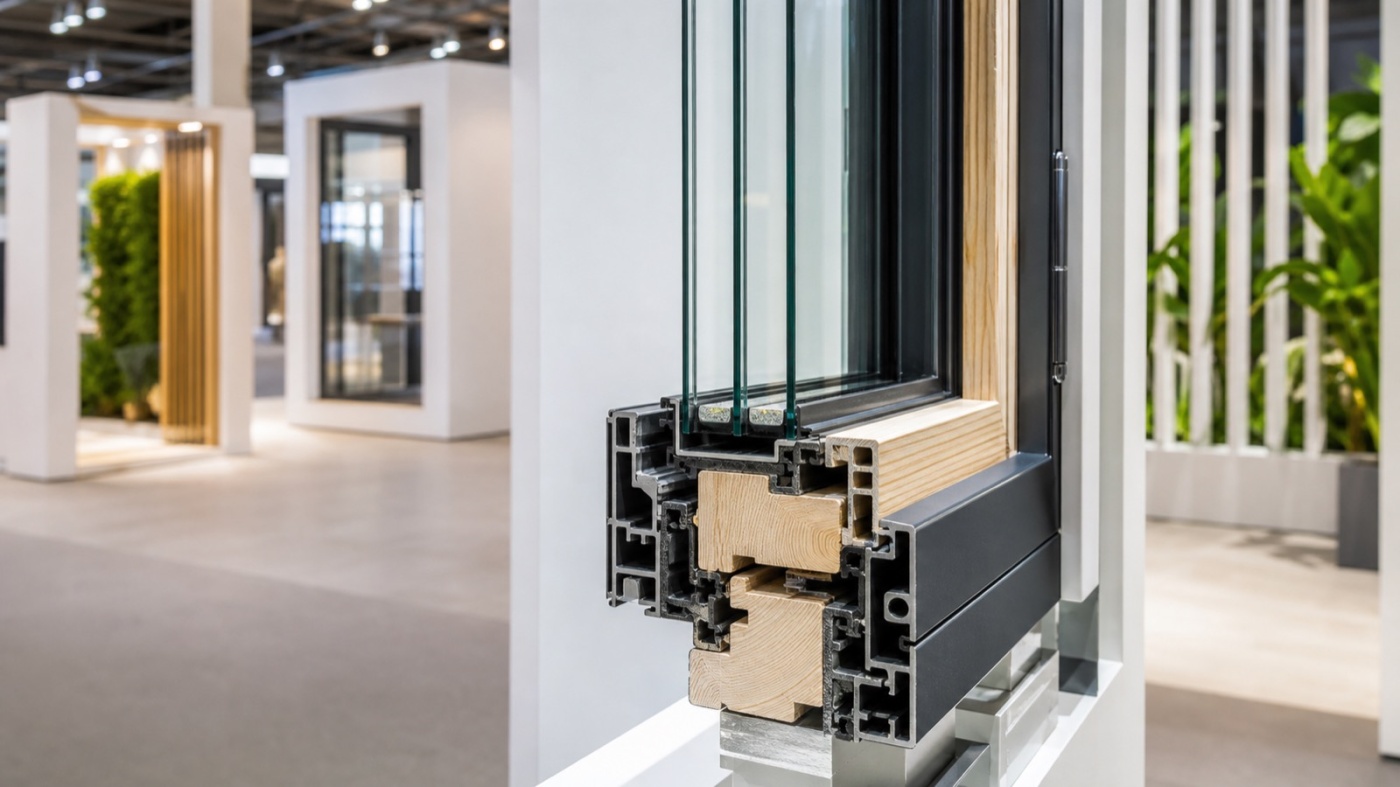
Every two years Nuremberg turns into the meeting point for windows, doors and facades. Fensterbau Frontale runs in March alongside HOLZ-HANDWERK, and the companies exhibiting here arrive with real components: profile sections, glazing units, hardware, complete facade mock-ups. Those exhibits shape the budget far more than the square metre figure on the space contract.
Two fairs, one venue, one long visiting day
Fensterbau Frontale occupies a large part of the Nuremberg exhibition centre and has run in parallel with HOLZ-HANDWERK, the European trade fair for machinery and supplies in woodworking, for decades. NürnbergMesse publishes the exact hall allocation for every edition.
Two things follow for exhibitors. The visitor flow is broader than at a standalone event, because window fabricators, metal builders, joiners and carpenters all enter on the same pass. And the distances are long, so many visitors plan their route in advance and head for specific stands. A stand that stays legible from a distance earns real money here, because it turns passing traffic into conversations.
The show follows a two year cycle, and the editions up to 2032 are listed in our trade fair calendar. That rhythm shapes the entire calculation, and we come back to it at the end.
The exhibit sets the weight
A full size window element weighs several hundred kilograms, a facade sample with triple glazing considerably more. As soon as such components stand upright in front of visitors, the presentation becomes a structure: a load bearing substructure, secure anchoring and, depending on height, structural verification. These three items form the first major cost driver, and they arise long before the first graphic goes to print.
Weight brings a second driver with it: transport and time. Heavy elements travel on dedicated racks, call for lifting equipment on the build up day and extend assembly. Deciding early how many elements travel to Nuremberg, and at what size, keeps vehicles, time slots and crew properly costed and the build up day calm.
Demonstrating function outweighs describing it
Visitors at Fensterbau Frontale reach for the handle. They tilt, turn and slide, inspect seals, compare profile sections and count chambers. A stand that invites this movement keeps floor space free in front of the element, mounts it securely and specifies hardware that carries thousands of operations across the full run of the show.
Motorised elements, automatic doors, solar shading and building control raise the effort again: power outlets in the right places, cable routes inside the platform, control technology built into the furniture, and someone on the team who runs the demonstration with confidence. These items often reach the budget late. Include them right at the start and your calculation stays reliable.
System houses and component suppliers budget differently
Two types of exhibitor meet at this fair. Profile and system houses present brand worlds on large plots, frequently with a second level for meetings and hospitality. Suppliers of hardware, seals, tools or software work in a more compact way, with a high density of exhibits on tables, in display cases and on sample walls.
Both routes pay off once they match the objective. Large plots come with ancillary costs that grow disproportionately: more lighting, more cleaning, more stand personnel, longer build up and dismantling, and as a rule structural verification for the second level. Compact stands move the budget into detail, into cabinetry, lighting design and sample holders that make a small component look substantial. Our page on exhibition stand cost puts realistic ranges around all of this.
Costs that sit outside the stand invoice
Surprises usually arrive from outside the stand construction invoice. Space rental, mandatory charges, service connections for power, water and data as well as catalogue and pass services are billed to you directly by the organiser. Add travel, accommodation during a well booked show week, hospitality, sample shipping and storage between two editions.
A reliable budget keeps these blocks separate and still shows them on one sheet. That way you see immediately which lever moves which amount, and you keep room for the elements that genuinely perform on the stand.
The two year rhythm as a budgeting asset
This is exactly where the cycle of Fensterbau Frontale pays off. A stand created for 2028 can return in 2030, provided it is conceived as a system from the outset. Modular frames, exchangeable fabric graphics and a well considered floor plan cut the cost of the following edition substantially, because graphics and exhibits then carry the change. So calculate across two or three appearances rather than a single one. Companies exhibiting less frequently keep capital free and do well with a rented modular stand.
Everything starts with the same question: which exhibit takes the lead role in Nuremberg? Once that answer is settled, the rest of the calculation falls into place almost by itself. We are glad to work through that arithmetic with you for your next edition.