Every two years Chillventa brings the refrigeration, air conditioning, ventilation and heat pump sector together in Nuremberg. From 13 to 15 October 2026 it once again fills a large part of the exhibition grounds, according to the organiser with an additional hall. For exhibitors, planning therefore starts with one sober question: what will this appearance actually cost?
Two years of lead time, three days on stage
Chillventa is regarded as the world's leading trade fair for its sector and is organised by NürnbergMesse. Around a thousand exhibiting companies meet tens of thousands of trade visitors here, with the Chillventa CONGRESS opening the week at the congress centre. The hall allocation follows the logic of the industry: refrigeration technology, components, air conditioning and ventilation, and heat pumps each occupy their own areas, so visitors head straight for what they came to see.
The two year rhythm shapes budget logic far more than at annual fairs. A stand built in 2026 goes up again in 2028. Factoring that span in from the start leads to a completely different assessment of investment and storage than counting only three exhibition days.
Then there is the audience. Consulting engineers, plant builders, wholesalers and operators make decisions here with a long horizon. Conversations run accordingly long, which turns meeting space into a genuine budget item rather than a pleasant extra.
The four blocks of a trade fair budget
Split the budget cleanly into four blocks. This structure creates clarity for management and keeps items from appearing twice or slipping through entirely.
First, space costs. Stand rent per square metre, graded by stand form, plus mandatory charges such as media flat rates, waste disposal, exhibitor passes and the AUMA contribution. These run directly between you and the exhibition company and belong expressly apart from stand construction.
Second, the stand itself. Concept, 3D visualisation, engineering, production or rental of the system, graphics and print, furniture, lighting, flooring, media technology. Experience shows this is the largest single block.
Third, logistics and build up. Transport of stand and exhibits, assembly and dismantling, forklift or crane time, delivery slots, and storage until the next edition.
Fourth, operations. Stand personnel, travel and hotel during the fair week, catering, cleaning, pre fair communication and the follow-up. First time exhibitors regularly underestimate this block.
Cost drivers that weigh heavily at this fair
Several items carry far more weight at Chillventa than at a consumer goods fair.
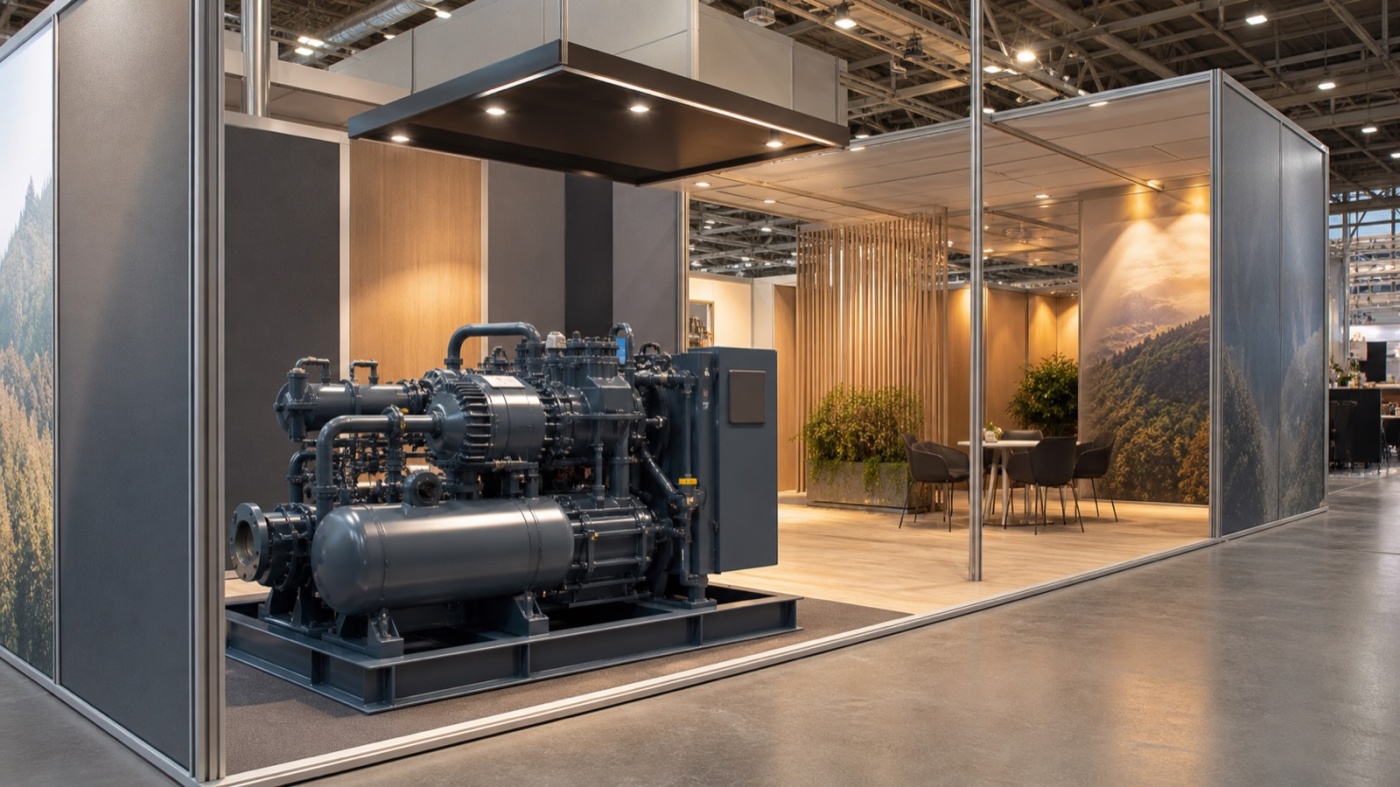
Heavy exhibits. Compressors, chillers, heat pumps and refrigerated cabinets bring serious mass with them. That creates requirements for floor loading, delivery windows and lifting equipment. Clarify weights and positions early, because relocating machinery later sends costs rippling through the whole chain.
Service connections. Running equipment calls for three phase power, sometimes water, waste water and extraction. These connections are ordered through the organiser, and orders placed during build up sit noticeably above the on time price. An early services plan saves real money here.
Meeting space. Because purchasing decisions in this sector are technical and long term, you will want seating. Every enclosed cabin consumes area, material and climate control. Derive the requirement from your planned number of conversations rather than estimating it.
International reach. The visitor field is international. Multilingual graphics, English data sheets and appropriately staffed shifts belong in the budget.
Fair week in Nuremberg. Hotel prices climb during this week. Booking rooms twelve months ahead keeps this item small.
Where you gain room to manoeuvre
Savings here come from structure rather than from cutting visible quality.
The biggest lever is modular system construction. An aluminium frame system with textile infills can be dismantled, stored and rebuilt in 2028. What changes in between are graphics, furniture and the exhibit zone. Across two or three editions the cost per appearance drops noticeably, and the reuse documentation supports ESG reporting as a welcome side effect. Our page on sustainable exhibition stands shows how this works in practice.
Consider the rental route as well. For a first appearance or an uncertain continuation, a rented exhibition stand is often the calmer decision, since storage and tied up capital fall away.
A third lever is discipline about floor space. A smaller, fully thought through area with a clear exhibit staging reads stronger than a large, half filled one. Before adding square metres, check whether your team can genuinely animate them.
When each decision falls due
A reliable budget grows in stages. Roughly twelve months ahead you register the space, which fixes size and stand form and provides the baseline for every other figure. About nine months ahead the concept and visualisation exist, so stand construction costs become dependable. Six months ahead, technology, connections and logistics turn concrete. Three months ahead come print data, staffing and travel bookings.
Keep a reserve of around ten per cent available. It covers late adjustments to the exhibit, extra connections or a change in neighbouring stands. A planned reserve reads far more professionally internally than a request for extra funds.
Four budget blocks make the appearance calculable
Chillventa is an appointment with a long echo: what stands in 2026 shapes 2028. A budget in four clear blocks, an early services plan and a system built for repeated use make the appearance genuinely calculable. For an idea of typical orders of magnitude, see our page on exhibition stand cost. We are glad to discuss your specific framework in person.