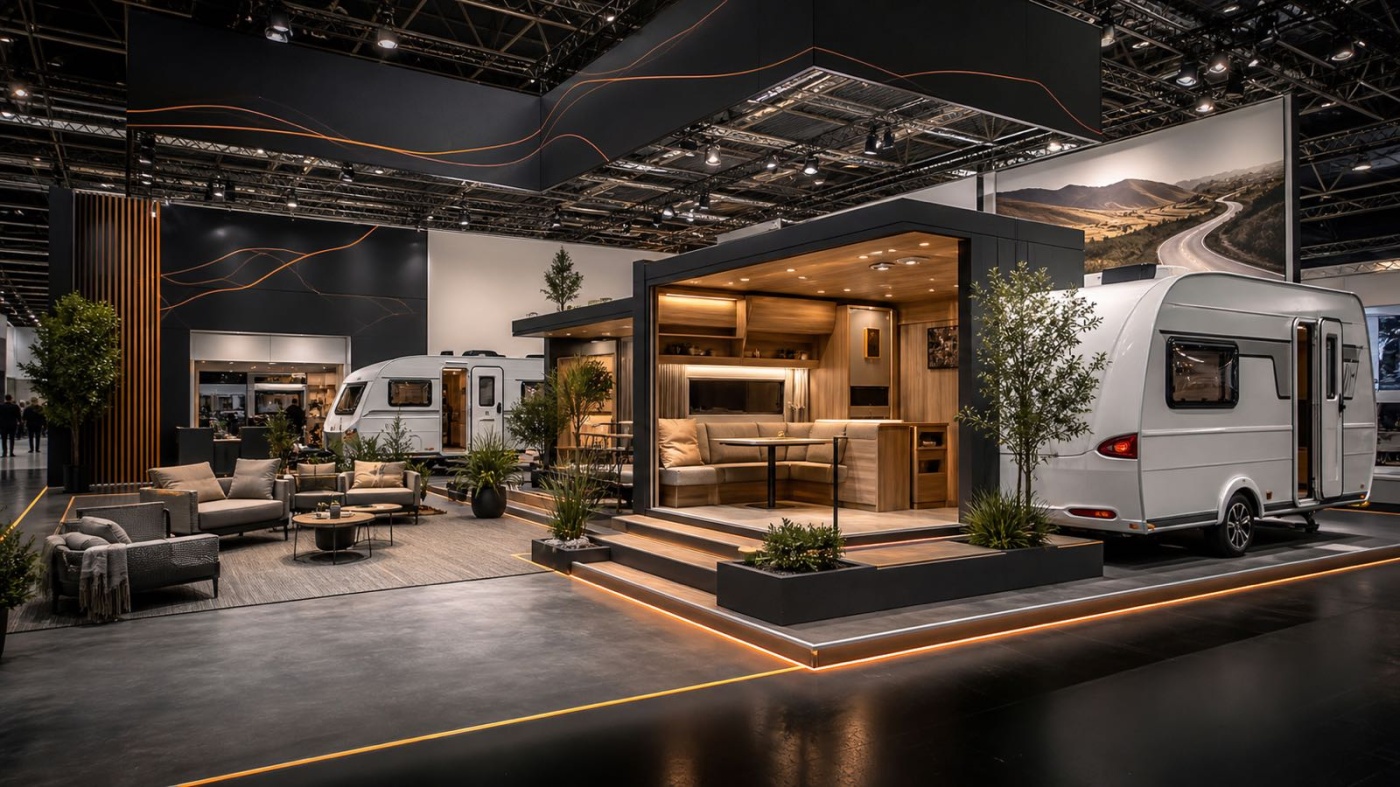
The CARAVAN SALON in Düsseldorf is one of the largest consumer trade fairs for mobile travel. Motorhomes, caravans, campervans, accessories and camping equipment take centre stage, and the audience consists mainly of private buyers who want to compare, step inside, touch and be advised. Anyone exhibiting here does not show small table displays, but often complete vehicles that are driven onto the stand, aligned and presented so that visitors can walk through them.
That is what makes stand planning for this fair special. An exhibition stand for the CARAVAN SALON has to be thought through from the outset in terms of access, manoeuvring, floor load and visitor crowds. This guide explains what matters about the Düsseldorf exhibition grounds, what demands large vehicle exhibits place on a stand and which deadlines and rules you should keep in view.
The CARAVAN SALON: a leading fair for mobile travel
The CARAVAN SALON sees itself as the world's leading trade fair for mobile travel and takes place every year in late summer in Düsseldorf. On show are motorhomes and caravans of every size, along with campervans, vehicle technology, tents, mobile homes, camping and outdoor equipment as well as travel destinations and pitches.
Unlike many trade-only fairs, the CARAVAN SALON is strongly geared towards the general public. Visitors come to compare vehicles and to get advice, often with a concrete intention to buy. For your appearance this means the stand has to accommodate many people at once, the routes must be wide and easy to read, and the exhibits must stay accessible without people bunching up in narrow spots.
You should check the exact dates of each edition in good time. For 2027, the CARAVAN SALON is expected to take place as usual in late summer, towards the end of August and the beginning of September. For the binding dates, please rely on the official page of Messe Düsseldorf for the CARAVAN SALON, as dates can change.
The Düsseldorf exhibition grounds at a glance
The Düsseldorf exhibition grounds lie in the north of the city, directly on the Rhine and close to the airport. For a fair with many large vehicle exhibits, the access is decisive. The A44 motorway takes you straight to the grounds, and the access for build-up and delivery is designed for large, heavy vehicles. If you are bringing whole motorhomes onto the stand, check the permitted approach routes, gate heights and manoeuvring areas against the organiser's documents early.
Part of the CARAVAN SALON traditionally takes place not only in the halls but also uses the open-air grounds. The outdoor area suits very large or especially tall vehicles as well as structures that need more space and driving movement than a hall can offer. Whether your appearance is better placed indoors or outdoors depends on the type of your exhibits, the presentation you want and the weather requirements.
Düsseldorf is well connected for visitors. The U78 light-rail line runs directly to the fairgrounds, and the airport is close by, so public days are busy and stands see a lot of movement, worth planning your routes and dwell zones for. For build-up and dismantling, fixed time slots and delivery rules apply. Because many exhibitors move large vehicles at once, allow enough buffer and coordinate delivery so that vehicles and build-up teams do not block one another.
Stand requirements for motorhomes and camping
Large vehicle exhibits shape stand planning at the CARAVAN SALON more strongly than at most other fairs. The first point is access onto the stand itself. A motorhome or a caravan has to be driven onto the stand area, turned and positioned to the millimetre. For this you need an open edge to the aisle, enough room to manoeuvre and a build-up plan that sets the order: the vehicle in first, then the stand around it.
The second point is the floor load. Vehicles put a high weight onto a comparatively small area, concentrated at single points on the tyres, and the hall floor and any structures such as podiums have to carry this safely. You will find the permitted floor loads in the fair's documents. If you place a vehicle on a podium, the construction has to be designed for it and, where required, verified by structural calculation.
The third point is the openness of the stand. At a consumer fair, low thresholds matter. Walk-in, open stands invite visitors to climb into the vehicles and move around freely, but crowding builds up quickly when things get busy. Plan wide routes, clearly separated entry and exit areas at the vehicles and enough free space so that queues do not block the rest of the stand.
Experience and consultation zones
Because visitors come with concrete questions and often with an intention to buy, advice plays a big role, so your stand should not only show vehicles but also offer room for quiet conversations. A set-apart consultation zone with seating, some distance from the busiest flow of visitors, helps to turn interested visitors into conversations and conversations into deals.
The fair also thrives on experience. Experience zones that hint at a camping situation, for instance with an awning, an outdoor kitchen or a seating area, make the offer tangible. Separate experience and consultation areas spatially, so that the bustle of one does not disturb the calm of the other. Clear zoning, dividing the stand into areas with different functions, is especially important given the often large surfaces of this fair.
Technical guidelines and deadlines
As at every large fair, binding technical guidelines apply in Düsseldorf. They govern build heights, escape routes, fire protection and the design towards neighbouring stands. Please read the currently valid version of the Messe Düsseldorf technical guidelines for the CARAVAN SALON, as values and deadlines differ from fair to fair and from year to year. The following points are among the most important topics to clarify before build-up:
- Stand construction approval: For stands above certain heights or with special structures, you have to submit dimensioned stand drawings, usually as a plan view and elevation at a fixed scale, on time before build-up. Construction only begins after clearance.
- Structural verification: Special constructions such as podiums for vehicles, overhead structures or suspended elements normally require proof of stability.
- Fire protection: Materials used must usually be at least flame-retardant, that is meet fire protection class B1. Additional requirements can apply to ceilings and overhead structures.
- Sight screens and neighbours: Towards adjoining stands, closed and cleanly designed rear walls as sight screens are usually required.
- Lead time: Approvals, connections for power and water and the registration of large exhibits have their own deadlines. Reckon on several weeks and start early.
The space rental, compulsory connections and similar ancillary costs are settled directly with the organiser, not with the stand builder, but should be factored into your planning from the start.
An exhibition stand builder for the CARAVAN SALON
A stand builder who accompanies you to the CARAVAN SALON ideally covers the whole path, from the first idea to dismantling: advice on the right stand size and form, the design with a spatial visualisation, the construction, the delivery and assembly on site and the storage of reusable components after the fair. At a vehicle-heavy fair in particular, it helps if planning and logistics are with one team, because vehicle positioning and stand build-up are closely interlinked.
die trendSETZEREI GmbH is based in Offenbach am Main and works throughout Germany, so for appearances in Düsseldorf as well. An own fleet makes it easier to deliver stand components to fair locations outside the Rhine-Main region. If you would like to compare the scope of services and the stand types in more detail, you will find an overview on the page about the exhibition construction services.
Choosing stand size and stand form
The right stand form depends on how many sides of your stand border a visitor aisle. With a row stand only the front is open, and the stand sits between two neighbours. The corner stand sits on a corner and is open on two sides, which brings more access and visibility. The end stand opens on three sides and usually lies at the end of a row. The island stand stands freely and is accessible from all four sides.
For vehicle exhibits, open forms are often at an advantage, because they make driving in and manoeuvring easier and give several groups of visitors access at once. An island stand allows viewing vehicles from several sides, while smaller appearances get along well with a corner stand. An overview of the stand types helps you place the differences and match them with your planned stand size. Bear in mind that vehicles tie up a lot of space, so an area that looks generous on the plan can feel tight with two motorhomes and visitor crowds.
Conclusion
The CARAVAN SALON in Düsseldorf is a consumer fair with large vehicle exhibits, wide visitor flows and its own rhythm of hall and open-air grounds. A good appearance therefore does not begin with the design, but with the practical questions: how does the vehicle get onto the stand, what does the floor carry, how do many people move at once, and which approvals and deadlines have to be met. Clarify these points early and observe the Messe Düsseldorf technical guidelines, and you save yourself a lot of stress during build-up.
If you are planning an appearance at the CARAVAN SALON, die trendSETZEREI GmbH supports you from the concept to dismantling, out of Offenbach and throughout Germany. Feel free to get in touch, by phone on +49 69 201 65 001 or by e-mail at info@dietrendsetzerei.de. You will find further ways to make contact on the contact page.