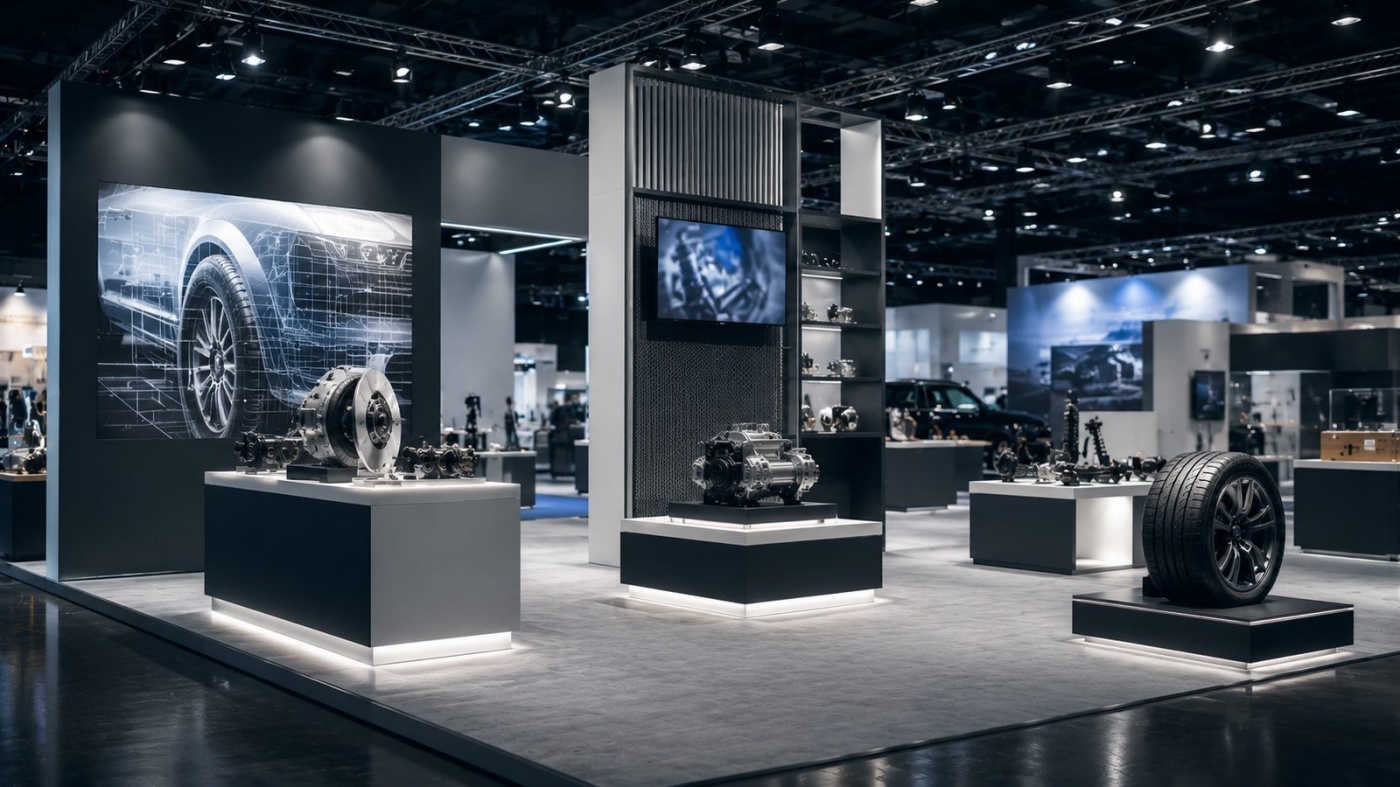
Automechanika Frankfurt is regarded as the leading global trade fair for the automotive aftermarket. It brings together spare parts, workshop equipment, tyres, accessories and the growing digitalisation of the sector, and it runs on a two-year cycle. The next edition is scheduled for 8 to 12 September 2026. Please confirm the exact dates through the official channels of Messe Frankfurt before you plan, because event dates can shift in advance.
Exhibitors at this fair meet an expert audience of retailers, workshops, fleet operators and industry buyers. An exhibition stand at Automechanika therefore has to demonstrate technical competence while safely carrying heavy or oversized exhibits. This guide walks you through the key conditions, from the character of the exhibition grounds and industry-specific stand requirements to the deadlines set out in the technical guidelines.
The character of Automechanika Frankfurt
Automechanika is a dedicated trade fair with an international reach. It presents parts and systems, workshop and service solutions, body repair and refinishing, tyres, accessories and software for diagnostics and business management. For exhibitors this means an audience that wants to inspect, touch and see products in operation.
A stand at Automechanika therefore relies less on pure appearance than on demonstrable function. Visitors expect a diagnostic device to run, a tool to sit in the hand or a component to be explained as a cutaway model. This expectation shapes the entire stand plan, from the layout of the floor space to the media technology.
The international character of the fair adds another layer. Exhibitors and visitors arrive from many countries, which makes clear and language-light visitor guidance valuable. Symbols, short texts and a recognisable route ensure that your message is understood even without a long explanation.
The Frankfurt exhibition grounds
The Frankfurt exhibition grounds rank among the largest and most tightly scheduled venues in the world. For Automechanika exhibitors, four aspects are especially important.
The first is the permissible floor load. Automotive exhibits such as lifting platforms, tyre changers, engine blocks or complete vehicles place considerable weight on small stand areas. The hall floors are robust, yet the specific permissible area and point loads differ by hall and position. You will find the governing values in the technical guidelines of Messe Frankfurt, so coordinate heavy structures early.
The second is robust product presentation. Heavy exhibits need load-bearing platforms, reinforced floor structures and a weight distribution that avoids peak point loads. Areas for heavy equipment should be defined in the construction stage so that the structural design matches the exhibit.
The third is delivery. Large machines and vehicles reach the stand through defined access routes, gates and time slots. Planning the logistics early prevents bottlenecks during the build-up days, when many exhibitors deliver at the same time.
The fourth is the manoeuvring and ceiling conditions. Check clearance heights, the load capacity of rigging points and the routes inside the hall, so that heavy goods reach their position safely. Here too the relevant technical guidelines are the binding basis.
Industry-specific stand requirements for automotive
Automotive exhibits place particular demands on an exhibition stand. Beyond weight, operational safety and media supply play a central role. Devices that are demonstrated need power, sometimes compressed air, occasionally water or extraction. These connections are ordered through the organiser and must be registered in good time.
Safety during live operation is just as important. When a lifting platform moves or a tool runs, protective distances, stability and accessibility have to be right. An automotive stand therefore combines solid construction with clear zones for demonstration, consultation and retreat.
Lighting also deserves attention. Metallic surfaces, coatings and technical details only work when the light shows them properly. Targeted illumination stages the exhibits without dazzling the viewer, and at the same time it supports safe work in the demonstration zone.
A modular system build is well suited to this, as the trendSETZEREI delivers through modular and custom exhibition construction. An aluminium frame with textile covering and integrated LED technology can be built stably, wired cleanly and reused for later fairs.
Planning workshop and demonstration zones
Many Automechanika appearances thrive on live demonstration. A workshop or demo zone shows products in genuine use and creates reasons to talk. For this to work, the zone needs enough circulation space, a clear line of sight for onlookers and a separation from quieter consultation areas.
A few guiding questions help when planning such zones:
- Which devices will be demonstrated, and what connections, protective distances and floor loads do they require?
- Where do onlookers stand without obstructing operation or escape routes?
- How are noise, chips or fluids contained so that the zone stays clean?
- How do visitors quickly reach a contact person after the demonstration?
Clarifying these points early combines show value with safety. The demo zone becomes the heart of the stand without disrupting the consultation flow.
Technical guidelines and deadlines
Every stand build at Automechanika is subject to the technical guidelines of Messe Frankfurt. Among other things they govern building heights, restricted construction zones, escape routes, screening towards neighbouring stands and fire safety requirements. Stand materials generally have to be at least flame retardant, which corresponds to building material class B1.
The deadlines are also binding. Dimensioned stand plans must be submitted for approval before build-up begins, and special structures often require structural proof. The exact deadlines and limit values vary by fair and by year. Always take these details from the current technical guidelines of Messe Frankfurt and do not treat any general deadline as universally valid. You will find further details about your participation on the official Automechanika website.
An exhibition stand builder for Automechanika
A full-service stand builder handles the whole chain for Automechanika, from consultation through design and 3D visualisation to production, logistics and assembly. With heavy automotive exhibits in particular, it helps to have a single contact person keeping structural design, connections and deadlines in view.
trendSETZEREI GmbH is based in Offenbach am Main, only a short drive from the Frankfurt exhibition grounds. Short distances mean more room to react during the build-up days, for example when something needs to be adjusted or additional material has to be supplied at short notice. This proximity makes coordination with the organiser and hall logistics easier.
Stand size and stand shape
The right stand size depends on your exhibits, the demonstration operation you want and your consultation needs. Heavy equipment and workshop zones require more space than it seems at first glance, because circulation and protective space surrounds every exhibit.
The stand shape also influences the effect. A row stand is open on one side, a corner stand on two, a peninsula stand on three and an island stand is accessible from all sides. For Automechanika, with its open demonstrations, more open shapes often improve visitor flow. Which shape suits your goal is explained in the overview of exhibition stand types. Factor the permissible floor load into the choice early so that area and weight match.
Conclusion
A convincing exhibition stand at Automechanika combines structural strength with clear function. Anyone who considers floor load, connections, demo zones and the deadlines of the technical guidelines together at an early stage builds safely and effectively. Always verify the fair dates and all technical values through the official channels of Messe Frankfurt.
If you would like to plan your appearance at Automechanika, trendSETZEREI GmbH supports you from Offenbach. Get in touch through the contact form, by phone on 069 201 65 001 or by email at info@dietrendsetzerei.de.