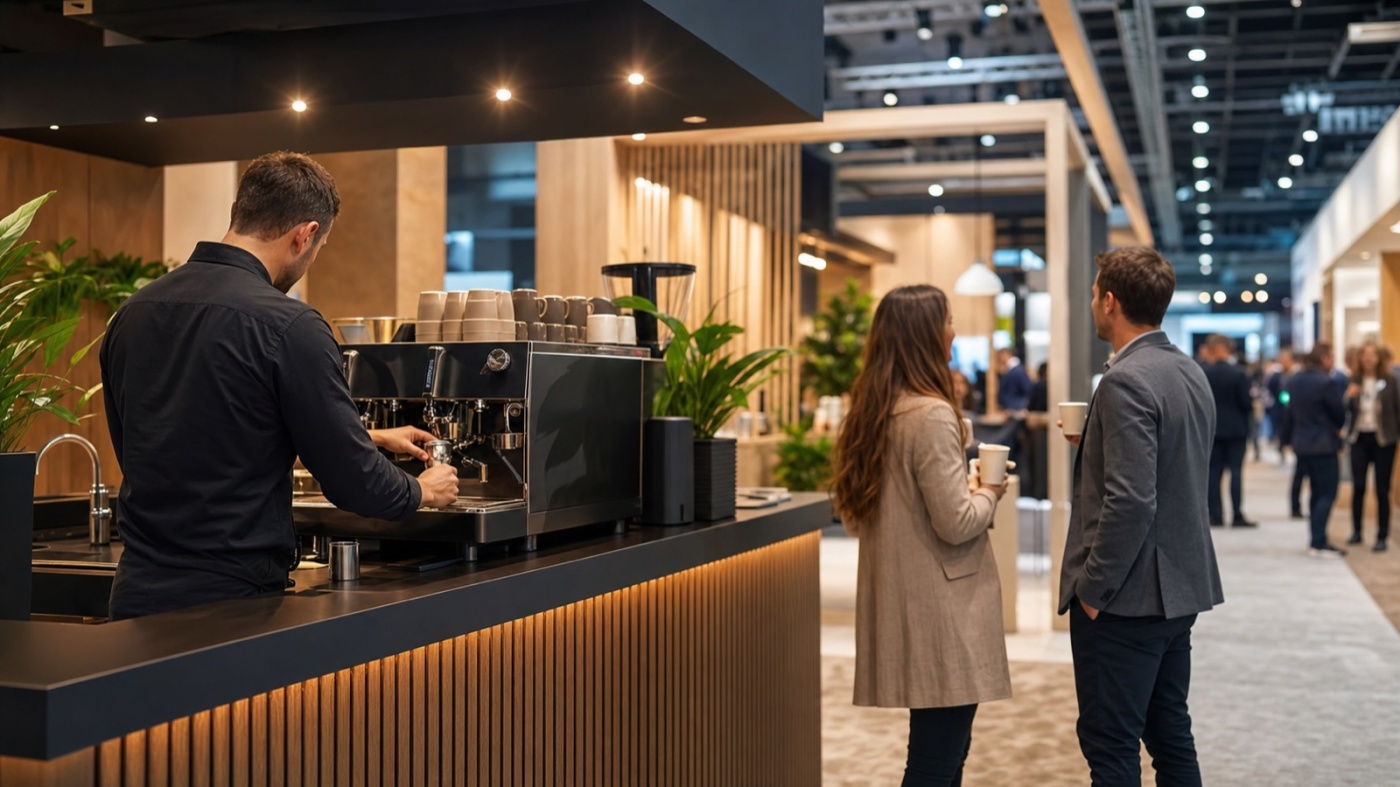
An espresso takes about four minutes, from order to empty cup. That is often exactly the span a first conversation needs to move from a friendly opening to the actual task. Catering on an exhibition stand is therefore less about gastronomy and more about conversation design, and it belongs in the plan early.
What a drink changes in a conversation
A drink buys the conversation time. Someone holding a cup stays put, and thirty seconds of politeness turn into a few minutes of exchange. That is the window in which the information your sales team works with after the fair actually appears.
Hospitality also lowers the threshold for stepping onto the stand at all. An open coffee counter at the aisle edge reads as an invitation without a word being spoken. For your stand team it is a natural opener: asking how someone takes their coffee starts more conversations than any prepared line.
Two details keep the effect stable. First, speed: a machine that needs three minutes per cup produces queues instead of conversations. Second, handling: finger food that leaves one hand free suits a trade fair conversation far better than a plate with cutlery.
Whatever gets discussed at the counter deserves to be documented afterwards, with the explicit consent of the person you spoke to. Our page on trade fair lead capture describes how to do that cleanly.
Know the house rules of the venue
On the exhibition grounds the venue operator holds house rights, and catering is usually regulated in detail. Three models are common: an exclusive in-house caterer, a list of approved partners, or admission of external providers against a fee. Some venues allow self-catering on a small scale, such as coffee and packaged snacks, and reserve hot food for the caterer.
Clarify these points before a kitchen unit appears in the design:
- Which caterers are approved, and what fee applies to external providers?
- What registration deadlines apply to utilities, vehicle access and passes for service staff?
- Which dishes and preparation methods are permitted on the stand area?
- How does delivery work during show days, and when do the gates open?
The answers sit in the service handbook and the technical regulations of the respective fair. They differ noticeably from venue to venue, which makes a fresh look worthwhile for every event.
Hygiene and law: the short compulsory part
As soon as you hand out food, food law applies, including when you serve free of charge as part of your appearance. In practice that comes down to three things.
First, hygiene. European food hygiene law requires an own-check concept based on HACCP principles, alongside an intact cold chain, clean work surfaces and a hand washing facility in the preparation area. In Germany, anyone handling food needs an instruction under the Infection Protection Act before starting work.
Second, allergens. For loose, unpackaged food, allergen information is required, either given verbally with written documentation kept on the stand or displayed directly. A small card beside the display handles it elegantly and reads as attentive service.
Third, alcohol. Serving alcoholic drinks falls under German hospitality law and generally requires a temporary permit. At trade fairs the caterer or the venue often takes care of this, so settle responsibility before a champagne reception enters the programme. Youth protection rules apply on the stand as everywhere else.
An approved fair caterer brings these records along. With self-catering they rest with you as the exhibitor, and that difference weighs more than the saving per cup.
Equipment, space and waste
Catering needs square metres, and they sit behind the counter. A working area holds the machine, a sink, a fridge, work surface, storage for crockery and drinks, plus separated waste bins. Two to four square metres of back-of-house space is a realistic starting point, depending on the scope of your offer.
Register your connected loads in good time. Professional machines quickly reach several kilowatts, larger models run on three-phase power, and water and waste water connections are ordered from the organiser as well. Where a connection is unavailable, caterers work with fresh and waste water canisters, which runs reliably and caps the volume you can serve.
Hot food brings further requirements, such as grease separators, extraction and rules for open flames. Waste disposal is regulated too and often carries a fee. Reusable crockery reduces the volume noticeably and fits an appearance that takes resources seriously; our page on sustainable exhibition stands goes into detail.
One point tends to surface only on build-up day: coffee machines, fridges and glass washers make noise. Place them at a distance from the meeting area, otherwise the grinder competes with your best conversation of the day.
People, menu and daily rhythm
Catering ties up people. The moment your sales team starts making coffee on the side, conversation capacity drops precisely during peak hours. A dedicated person behind the counter usually pays off from the second day onwards, and a barista becomes an attraction in their own right.
Keep the offer lean. Two coffee variants, water, one more soft drink and a small bite cover the majority. A regional selection plus one vegetarian and one vegan option signal attention with manageable effort. Plan quantities from the visitor forecast and stand size, with resupply rather than full stock on day one.
The rhythm of a fair day helps with the detail: mornings belong to coffee, midday to water and small bites, and in the late afternoon a drink noticeably extends conversations. A short daily schedule keeps counter and team in step and makes reordering simple.
The counter belongs in the first draft
Catering is a tool for conversation quality. It works when space, equipment, law and staffing fit together. Add it after the stand design and the counter ends up squeezed between exhibits; plan it in from the start and you gain minutes in every conversation. For the right scale on your floor area, a short conversation about your layout is the fastest route.