A stand in Chicago, Dubai or Milan pursues exactly the same goals as one in Frankfurt, and it runs on entirely different mechanics. Power, fire safety, customs and labour organisation are governed nationally, and that is where the calm of your show week is decided. Here is what exhibitors look at early once the hall sits outside Germany.
Three routes to a stand abroad
Three models have proven themselves for building outside your home market, and the choice usually comes down to stand size and frequency.
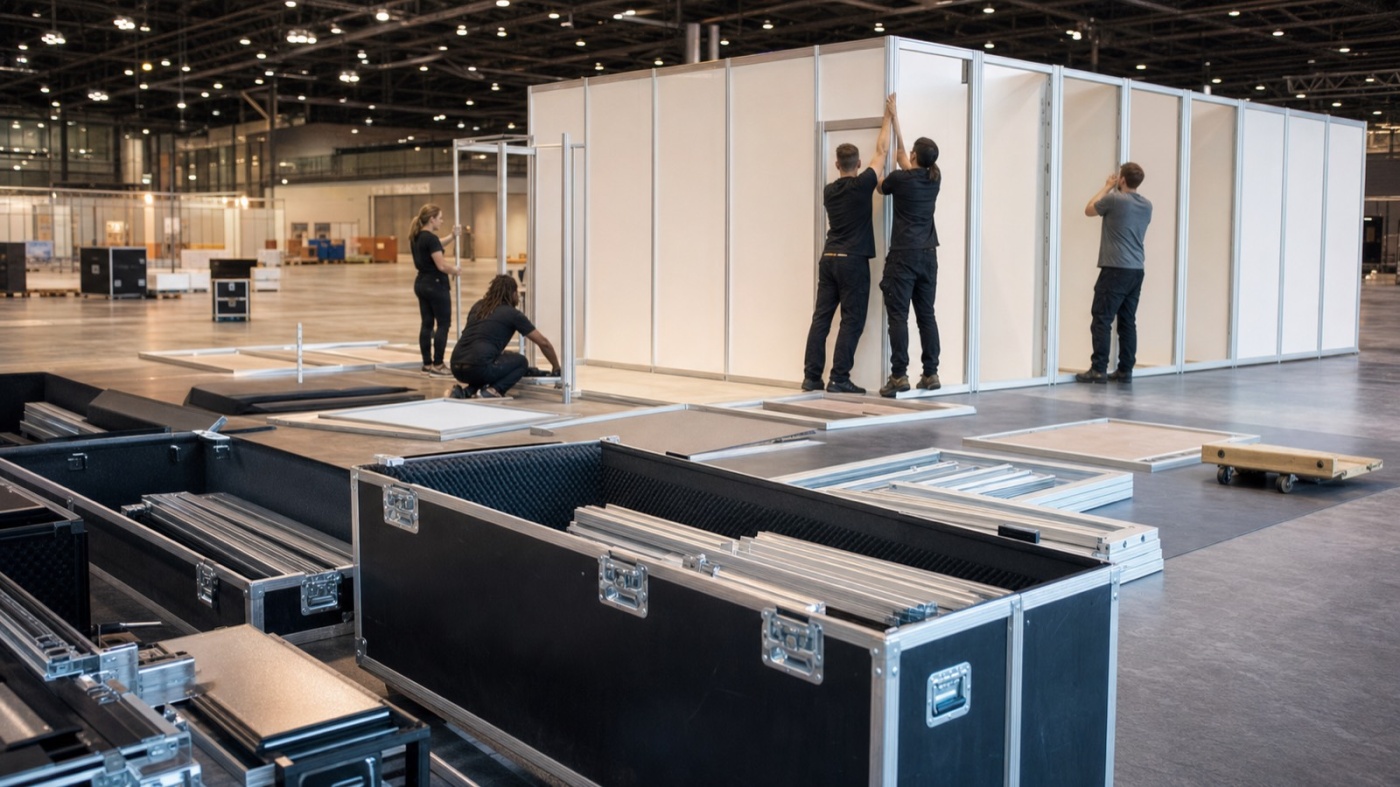
On the first route, your own stand travels with you. A modular system stand packs into cases, flies or sails to the venue and gets assembled on site. It pays off as soon as the same appearance happens several times a year, because design, graphics and fit stay identical across every date. Whether the numbers work depends on how often you exhibit; our overview of rental and system solutions puts that into perspective.
On the second route, a local stand builder produces to your design. Concept, CAD drawings, material lists and print data come from Germany, while production and installation happen in the destination country. That saves freight and customs effort, and in return it asks for precise construction documents, because the details get interpreted on site.
On the third route, the organiser or a joint pavilion hands over a finished space. For a first look at a new market this is often the calmest entry, with modest room for design.
All three share one rule worth keeping: a single point of contact owns design, approvals and deadlines. Once time zones, languages and unfamiliar venue rules meet, that one named contact becomes the real success factor.
North America deserves a separate note. Many convention centres work with unionised trades: electrical, rigging and material handling inside the hall (drayage) follow defined jurisdictions. How much you may assemble yourself, and from which stand size specialists take over, is written in the exhibitor service manual of the specific show. Budget these lines early, because they behave differently from a familiar German build.
Technical details that change at the border
Power sits at the top of the list. Germany runs on 230 volts at 50 hertz, North America on 120 volts at 60 hertz, Japan on lower values still, and plug patterns and fusing differ alongside. LED technology with a wide-range power supply usually travels easily, while frequency-dependent devices, motors and coffee machines deserve a closer look. The stand connection itself gets ordered from the organiser, and those deadlines often fall weeks before build-up.
Certification follows. In North America many venues expect electrical equipment carrying a UL or ETL mark, so your European CE marking gets complemented by the locally recognised proof. On fire safety, Germany typically works with flame-retardant class B1, US venues frequently reference NFPA standards for textile materials, and France uses its M classes. Carry the material certificates in English or the local language and stand approval moves noticeably faster.
Build heights, restriction zones and approval deadlines are set by each venue operator individually. The binding figures live exclusively in the technical regulations of the specific event, and those documents belong on the table before the first sketch.
Customs: the ATA Carnet and the official freight forwarder
For goods travelling outside the EU, the ATA Carnet is the central document. It works as an international customs passport for exhibition goods, stand equipment, samples and demonstration units, is issued by the competent chamber of commerce and stays valid for one year. Around 80 states accept it, and several trips are possible within that validity. What really counts is the re-export deadline that customs in the destination country sets on entry.
Two points generate most of the questions in practice. First, everything imported under a carnet leaves again in full and unchanged, serial numbers and quantities included. Second, consumables take a different path: giveaways, brochures, catering and consumable materials stay in the country and therefore go through regular importation with duty and import VAT. Inside the EU goods move freely, and a carnet is reserved for special cases such as the Canary Islands, Ceuta and Melilla or the French overseas départements.
Many organisers also appoint an official show freight forwarder who serves the hall and controls delivery windows, interim storage and empty case handling. Consign your freight there and the goods arrive reliably at the stand. On transport mode, a simple rule of thumb applies: sea freight counts in weeks, air freight in days at considerably higher cost. Put that buffer into the schedule before the first freight quote arrives.
Language, team and lead time
Six to twelve months of lead time already feels comfortable at home. Abroad, freight, customs paperwork, translation and extra approval loops join the plan, so the start moves earlier. A look at upcoming trade fair dates shows which slots are realistic.
Watch the detail in your documents. Drawings for North American shows work in inches and feet, graphic copy gains from proofreading by native speakers, and a claim that lands in German deserves its own English version rather than a literal transfer.
Local reinforcement helps on the stand itself. Native-speaking staff or interpreters lower the threshold in the aisle noticeably, and they know the customs from greeting to business card. Sort visas and entry formalities for the installation crew early too, since those timelines run independently of the show.
One aside: the German federal government supports participation in joint pavilions abroad through its foreign trade fair programme, and individual federal states run schemes of their own. Registration deadlines fall long before the event, so an early check is worthwhile.
What makes an international appearance predictable
The difference between a relaxed and a hectic show abroad sits almost entirely in the preparation. Modular systems travel well because they assemble with few tools and serve many times over. Precise construction documents make local partners fast. And a complete document folder holding the carnet, material certificates, floor plan and connection loads answers most questions right there in the hall.
If a specific international show is ahead of you, an early look at floor area, freight route and schedule helps more than any generic checklist. Our exhibition stand services show how the process runs from concept to installation.