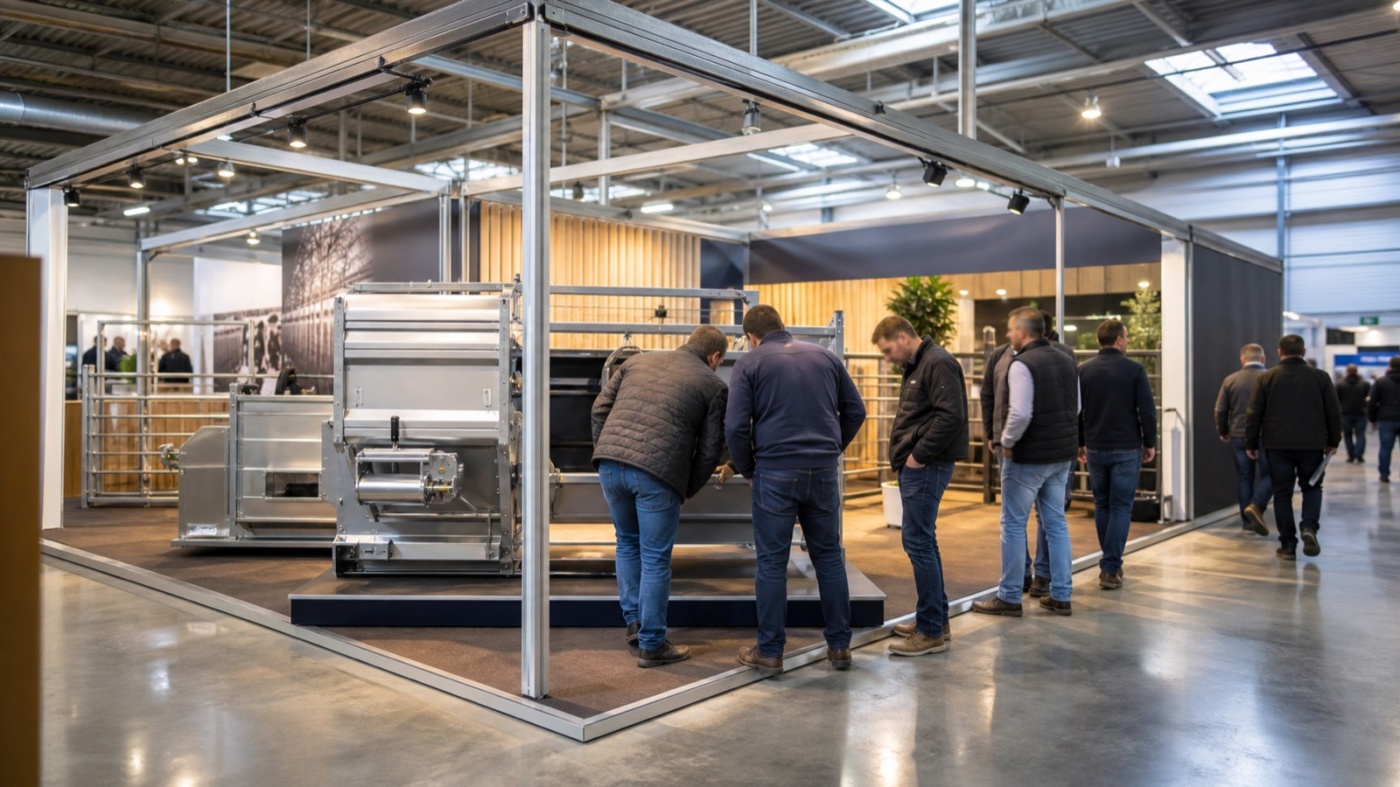
In agriculture, a show season rarely comes down to a single date. Regional fairs in summer are followed by field days, dealer events and, in November, the big appearance in Hanover. A stand built to serve that whole chain works for you all year rather than for four days.
Hanover in November: technology visitors want to touch
EuroTier is the world's leading trade fair for professional animal farming and livestock management, organised by the DLG. The coming edition runs from 10 to 13 November 2026 at the Hanover exhibition grounds, with further editions in 2028, 2030 and 2032. More than 2,100 exhibitors from over 50 countries are expected across roughly 220,000 square metres, alongside EnergyDecentral for decentralised energy supply and the Inhouse Farming Feed & Food Show. The DLG runs the 2026 edition under the guiding theme "Intelligence in animal farming".
The exhibition programme spans breeding animals and breeding programmes, feed and feed storage, barn and hall construction, housing and feeding technology, climate and environmental technology, milking and cooling technology, manure handling, transport, processing, marketing and consultancy. Exhibitors here typically show machines, components and systems that visitors open, handle and assess in detail.
That shapes the stand. The audience consists of practitioners: farm managers, contractors, advisers, veterinarians and buyers who arrive with concrete questions and time to spend. Conversations run longer than at many consumer goods fairs, often standing at the exhibit and finishing at a meeting table. Hard-wearing surfaces, well-lit machinery and enough seats therefore pay off more than an elaborate façade. You will find this date and other agricultural shows in our trade fair calendar.
A core that stays, modules that change
The idea behind a modular presence is simple. You own a base set of components that suits every date, and you add a small number of show-specific elements each time.
The core consists of system frames, wall surfaces, counter, storage room, lighting and flooring. Aluminium frames in standardised grid dimensions join together tool-free into different floor plans. The same elements form a head stand with forty metres of wall in Hanover and, in summer at a regional show, a compact in-line stand that travels in two transport cases.
The changing part is the graphics. Fabric prints can be washed, stored and reprinted while the frame stays as it is. That way you carry your international message to EuroTier, your home-market message to the regional show and your service topic to the dealer day, all on the same structure.
A third building block is the exhibit platform. Plinths, ramps and podiums in consistent heights hold heavy equipment safely and swap freely between shows. At one date they carry a milking technology component, at the next a barn ventilation model.
What travels and what is produced fresh
The dividing line follows service life.
Everything whose message stays stable across years belongs in the travelling set: the illuminated company logo, stand furniture, technical fittings, screen mounts, cable routing, cloakroom and storage cabinet. These items incur their cost once and afterwards only transport, assembly and care.
Content with an expiry date deserves fresh production: product launches, campaign imagery, prices and performance figures, show-specific promotions. Keep that content deliberately on a few surfaces, for example one central graphic wall and two changeable frames. The reprint per date then stays manageable.
Two points reward early attention. First, floor loads: barn technology, drives and tanks bring weight with them, and the technical guidelines issued by Deutsche Messe govern permissible loads as well as delivery. Clarify weights and delivery time slots with the organiser and your stand builder early on. Second, cleaning: agricultural audiences come straight from practice, and the flooring takes the traffic. A durable covering in mid tones handles four days with ease and stands up to repeated use.
The maths across a show season
A modular stand costs more to buy than a simple one-off construction. The calculation becomes interesting from the second appearance onwards.
Set the purchase value against the appearances it carries. With three dates a year, the core spreads across three budgets, and each date carries transport, assembly, graphics changes and space rental. Across two show seasons, with the next EuroTier already in view, the total often lands below the cost of three to six separate builds. Our page on exhibition stand cost breaks down the individual items.
A softer effect comes on top: recognition. Customers who saw your stand at a regional show in summer spot it immediately in Hanover in November. A consistent stand image works like a signature across the season.
If your calendar holds a single date every two years instead, renting a system stand remains the more economical route. Both models combine well: your own core plus rented additional areas for the flagship appearance.
Storage, inspection, reuse
For the maths to work, the stand needs orderly conditions between dates.
After dismantling, every component moves into storage with a record and, ideally, a digital inventory entry including its condition. Damaged frames and fabrics get repaired or replaced while time allows, rather than shortly before the next build-up. Electrics and lamps deserve regular testing.
Graphics benefit from the same discipline. Filing print data with dimensions, colour profile and date means the next reprint takes hours instead of days. Our exhibition stand services describe how we organise storage, inspection and reuse.
What to take away from Hanover
EuroTier rewards exhibitors who plan their entire show season and treat Hanover as the strongest point in a chain. A modular core of system frames, furniture and platforms carries the regional show, the dealer day and the world leading trade fair alike, while changing fabric graphics deliver the message of the moment.
As you put together your 2026 dates, it is worth talking through the common denominator of those appearances. That single question often produces the biggest gain for both budget and impact.