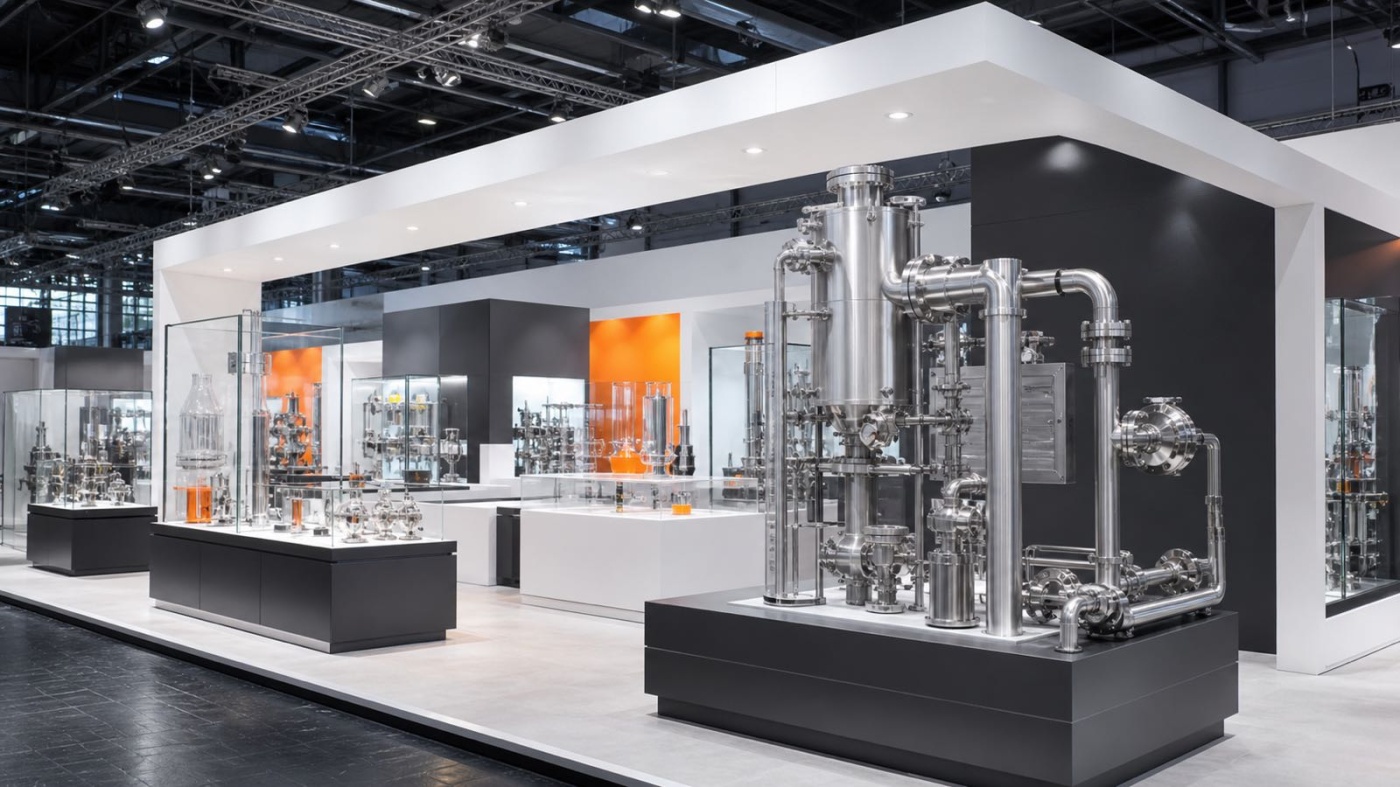
ACHEMA is regarded as the world forum for the process industry, bringing specialists from chemistry, pharmaceuticals, biotechnology and process engineering together in Frankfurt am Main. Companies that exhibit here rarely show flat brochure walls; they present large technical apparatus, complete plant modules and working processes. That places particular demands on stand planning, because heavy exhibits have to stand safely, receive their supply connections and, first of all, physically reach the hall.
This guide sets out, in factual terms, what matters for an exhibition stand at ACHEMA: the character of the event, the Frankfurt grounds with their floor load and moving-in demands, the requirements for large apparatus, and the guidelines and deadlines you should keep in view. The aim is a sober overview for your own preparation.
ACHEMA in brief
ACHEMA is an international trade fair and congress for the process industry. It takes place in Frankfurt am Main and is staged on the city's exhibition grounds. The name goes back to a historic German term for an exhibition and conference on chemical apparatus engineering, and today the event stands for the whole field of industrial material processing. Unlike many annual fairs, it is held on a three-year cycle. According to current information and the details on the official ACHEMA channels, the coming edition is planned for 14 to 18 June 2027. Always take the binding date and all detailed information from these official channels, as such details can change.
In terms of content, the fair covers the complete process chain of the chemical, pharmaceutical and biotechnology sectors, from pumps, compressors and valves through heat and mass transfer apparatus, measurement and control technology and laboratory equipment to solutions for digitalisation, energy and environmental protection. Visitors come from engineering, production, research, procurement and plant planning, and they scrutinise technology very closely and prefer to discuss concrete application questions. A stand at ACHEMA is therefore less a shop window than a place to work.
The Frankfurt exhibition grounds
The Frankfurt grounds are divided into several large halls that differ in size, ceiling height and load capacity. For a stand carrying heavy technical apparatus, the permissible floor load of the hall is one of the most important starting figures. Plant modules and pressure vessels quickly place a considerable weight on a small footprint, and the hall floor must not be overloaded by that point load. The relevant values for your hall are held in the technical guidelines of Messe Frankfurt, and very heavy exhibits can require a load distribution across a suitable sub-construction.
Moving in is just as important. The dimensions of the hall gates, the load capacity of the internal routes and the available clearance height determine which path an exhibit can take and whether a forklift or a crane is required. Discuss this early with your stand builder and forwarding agent, so that the intended stand position matches the transport route that is actually possible.
Closely linked to this is delivery during build-up and dismantling. Messe Frankfurt controls traffic on the grounds through a central traffic management system, in which exhibitors, stand builders and forwarders register their access in advance. For heavy plant this is especially relevant, because abnormal loads, time windows and lifting equipment all have to be coordinated. An orderly delivery avoids waiting times at the gates and gets the exhibit to the right place at the right moment.
A further point is the supply connections. Power, in part high-voltage current, together with water, compressed air and data lines, is fed in through the hall floor and must be ordered from the organiser in advance, and their precise position feeds into the stand planning.
Exhibition stand at ACHEMA: requirements for the process industry
The biggest difference from many other fairs lies in the weight, size and operation of the exhibits. An apparatus or a plant module often puts several hundred kilograms or more on the floor, and that brings structural stability to the fore. Both the stand structure and the hall floor have to carry the load, and the permissible values are set out in the technical guidelines of Messe Frankfurt. The height and footprint of the exhibit also shape the stand layout from the outset.
Supply is a further factor. If an apparatus runs in demonstration mode, it needs more than a single socket, often high-voltage current, water or compressed air, and in some cases drainage for media. These requirements should be settled early, as they determine both the connection order and the routing of lines on the stand. Live demonstrations also call for safety distances, screening and a calm operating area.
Areas for explaining and demonstrating matter too. Technical relationships are best conveyed at the exhibit itself, supported by cutaway models, screens showing process data or tangible sample parts. For the apparatus to appear credible, a calm, engineering-led design counts for more than loud effects: clear materials, good lighting and tidy cable management underline the technical competence the audience expects.
Consultation and meeting zones
Because ACHEMA is a working fair, the way the stand is zoned has a strong influence on success. Specialist conversations here are often long and detailed and need quiet, so a clear division into areas that work together is sensible.
- An open demonstration and explanation area at the exhibit, where visitors can pause and see technology in operation.
- A quieter consultation and meeting area for in-depth technical talks, partly screened off or set up as a closed meeting room where needed.
- A compact zone for sample parts and documents that bridges the move from watching to talking.
This arrangement guides visitors: the running exhibit draws attention from the aisles, the sample parts invite people closer, and the meeting area captures concrete interest. Because many appointments at ACHEMA are arranged in advance, allow enough space for undisturbed conversations.
Technical guidelines and deadlines
As at every event on the Frankfurt grounds, the technical guidelines of Messe Frankfurt apply at ACHEMA as the binding basis. Among other things, they govern construction heights, restricted construction zones, escape routes and screening walls towards neighbouring stands. For stand construction you will as a rule need a stand construction approval, for which you submit dimensioned stand plans with floor plan and elevations. These plans must reach the organiser in good time before build-up begins, and construction only starts once the approval note has been given.
For special constructions, such as double-decker stands, suspensions or larger structures, Messe Frankfurt additionally requires structural proof, checked by an independent body. For the stand construction materials used, at least building material class B1, that is flame retardant, generally applies. Take the exact values, classes and submission deadlines from the technical guidelines of Messe Frankfurt in the version valid for your exhibition year, as details can change. What matters is the lead time: approval, structural checking, moving in heavy apparatus and connection orders all take time, so the plans should be in place several weeks before build-up.
An exhibition stand builder for ACHEMA
A stand builder familiar with the processes at Messe Frankfurt takes a large part of this organisation off your hands. From concept through construction and production to logistics and assembly, the entire sequence can be managed from one team. For technical stands with heavy apparatus this is an advantage, because stand statics, media planning, moving in and delivery all have to be closely coordinated.
As an exhibition stand builder based in Offenbach am Main, the trendSETZEREI GmbH is only a few minutes from the Frankfurt grounds, which makes build-up, dismantling and quick adjustments during the fair easier. For the stand structure, a modular system build lends itself well, with an aluminium frame that can be flexibly combined and reused for later fairs. You can find an overview of the range of services on the page about exhibition stand construction in Frankfurt.
Choosing stand size and stand form
Besides size, the stand form determines how your presence comes across. A row stand is open only to the aisle side and suits a focused appearance on a small footprint. A corner stand sits on two open sides and offers more visibility. The end stand opens on three sides and appears distinctly more prominent. The island stand is accessible from all four sides and gives a large apparatus plenty of room, but brings higher demands on planning and preparation.
At ACHEMA in particular, the right form is closely tied to the exhibit. An apparatus meant to be seen working from several sides comes into its own on an end or island stand, while a row stand calls for a clear line of sight to the demonstration area. Plan the zones for demonstration, consultation and sample parts together with the stand form, so that walkways and sightlines stay coherent. You can compare which form suits your goals by looking at the stand types.
Conclusion
A successful appearance at ACHEMA begins long before the build-up day. Anyone who thinks through the floor load, the moving in of heavy apparatus, the delivery, the media supply and the technical guidelines early avoids costly surprises and can concentrate on what counts at the fair: the technology in operation and the specialist conversation. The binding dates and requirements always come from the organiser; everything else can be well prepared with careful planning.
If you are planning your appearance at ACHEMA and are looking for a partner for concept, construction and logistics, the trendSETZEREI GmbH supports you from Offenbach with a short journey to the Frankfurt grounds. You can reach us by phone at +49 69 201 65 001 and by email at info@dietrendsetzerei.de. For an initial assessment, feel free to use the contact form.