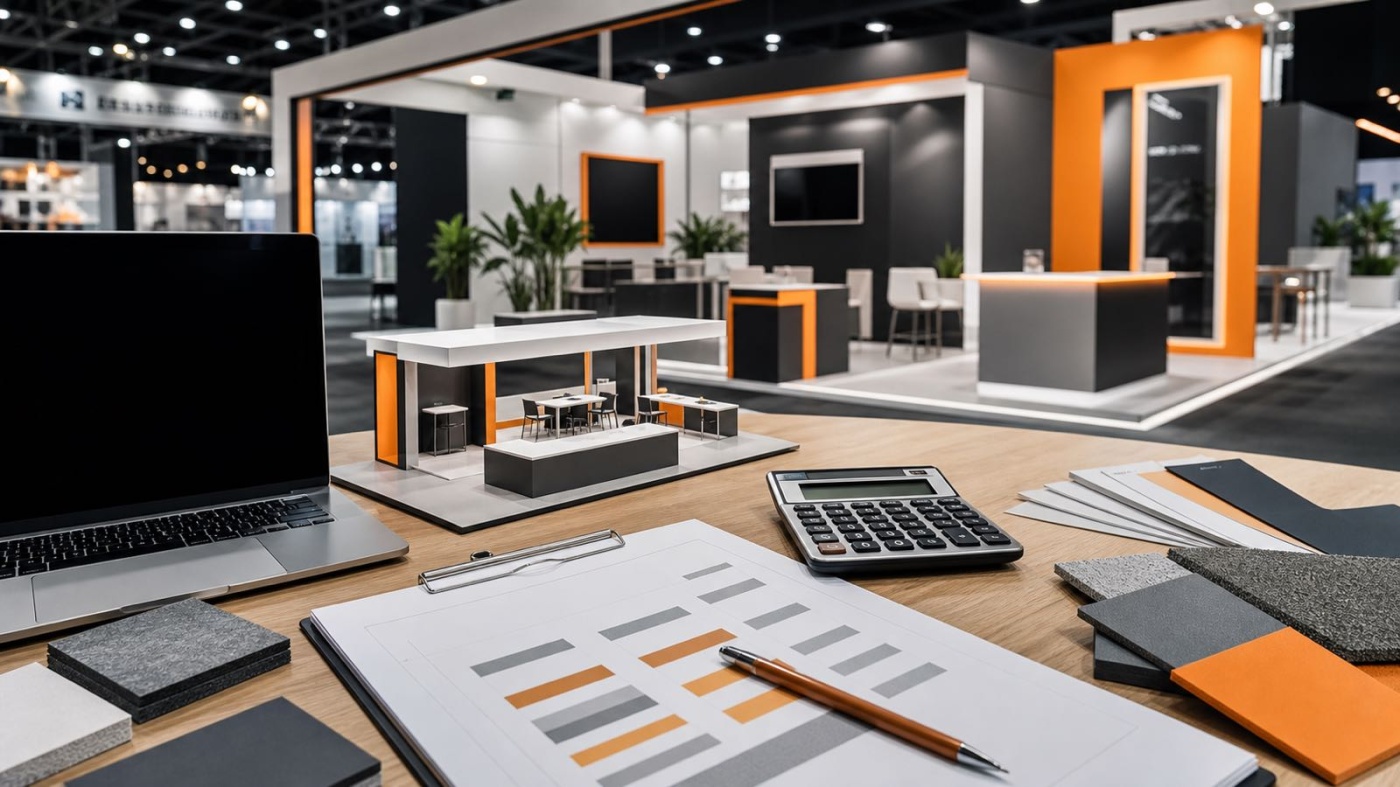
Anyone planning a first trade fair appearance quickly arrives at a single question: what does an exhibition stand actually cost? There is no flat figure, because the price depends on stand size, construction method, fit-out and the specific fair. More important than a single sum is therefore understanding which items make up an exhibition budget. Only once you know the individual building blocks can you plan seriously and avoid the typical pitfalls, where costs surface at the end that were never in the first quote. This article sorts through the main budget items and shows which side costs are often missed during planning. For a concrete cost orientation for your own project, see our page What does an exhibition stand cost.
Stand construction is only part of the budget
Many people equate the price of the exhibition stand with the cost of building it. Stand construction, meaning the structure, walls, floors, counters and the actual physical build, really is a large item, but it is only one of several. It covers planning, design, production in the workshop, and assembly and dismantling on site. How large this share turns out to be depends heavily on whether an individual stand is designed from scratch or a modular system stand is used.
The key is to separate stand construction from the costs that are not billed by the stand builder but by the fair organiser. This dividing line is where most misunderstandings arise. A quote for stand construction can be complete and fairly calculated and still only reflect part of what a trade fair appearance costs in the end.
Floor space rental and mandatory fees go straight to the organiser
Probably the most frequently overlooked point: you rent the stand space itself from the organiser, not from the stand builder. The space rental depends on square metres and stand form, meaning whether your stand sits along one side, on a corner, at the head of a block or free as an island. This rent is usually not part of the stand construction quote and is settled directly between you and the fair organiser.
On top of that come mandatory fees that many organisers charge. These often include a media or catalogue entry, an industry marketing levy for the exhibition sector, and, depending on the fair, further obligatory items. These amounts also run through the organiser. If you only keep the stand construction budget in view, you regularly underestimate the total. It pays to look into the exhibitor documents of the specific fair early, because these items are listed there.
Connections, power and technology are easily forgotten
A stand needs supply, and that too usually has to be ordered through the organiser. Technical connections include:
- Power connection including the base charge and consumption, often depending on the load required
- Water and waste water connection, as soon as a kitchen, a bar counter or a coffee point is planned
- Compressed air or internet and network connections, depending on your exhibits and presentation technology
- Rigging points for suspended trusses, banners or lighting from the hall ceiling
These connections cause two kinds of cost: the one-off provision by the fair and the actual consumption during the show days. Power consumption in particular is underestimated when a lot of lighting, large screens or kitchen appliances are involved. If you plan these items in early, the final invoice holds no surprises.
Graphics, furnishing, logistics and staff
Beyond the build and the connections there is a range of further items that shape the budget. Graphics and print cover the large-format cladding, logos, back walls and all visible brand elements. They largely decide how the stand looks and should not be treated as a leftover item.
Furnishing and technology range from counters, seating and display cases to screens, lighting and presentation equipment. Much of this can be rented, which is often more sensible than buying for a one-off appearance. Logistics brings the stand to the fair and back again, including transport, assembly and dismantling as well as storage between two uses. Working with an in-house workshop and vehicle fleet keeps these routes short.
Staff during the fair should not be forgotten either. Stand duty, hosts, catering and cleaning come on top. Stand cleaning is frequently overlooked, but on multi-day fairs it is a fixed item and is often booked through the organiser too. At the end of the fair, dismantling and the disposal of materials that are not reused are added. For an overview of how such items spread across the planning months, see our article on the timeline for a trade fair appearance.
Why rented and system construction is cheaper across several appearances
When it comes to cost, the construction method plays a major role. An individually built stand that is disposed of after the fair incurs its full cost afresh at every single appearance. A modular system stand, by contrast, is made of reusable components, such as aluminium frames with textile cladding, that can be recombined for each fair.
System construction can cost roughly as much to acquire at first as an individual stand, but it pays off clearly across several fairs, because the basic structure remains and only the graphics or the arrangement are adapted. If you exhibit several times a year or across several years, you noticeably lower the cost per appearance and at the same time reduce material use and disposal. For a single one-off appearance, on the other hand, renting a system stand can be the most economical solution, because no permanent purchase is needed. Which option is worthwhile therefore depends less on the pure square-metre price than on the number of fairs planned.
Cost logic instead of a flat price
The honest answer to the cost question is: it depends. A reliable budget does not come from a square-metre price but from the sum of many items, some of which run through the stand builder and some directly through the organiser. If you consider stand construction, floor space rental, connections, graphics, furnishing, logistics, staff and cleaning together from the start, you plan realistically and avoid nasty surprises on the final invoice. For a more concrete orientation for your project, see our page What does an exhibition stand cost. How all of this breaks down to a specific fair is shown in our fair-specific guides, for example on the exhibition stand for Automechanika or on the exhibition stand for Heimtextil.
If you would like to go through your budget for a specific appearance, feel free to get in touch. You can reach the trendSETZEREI on +49 69 201 65 001 or by email at info@dietrendsetzerei.de.